Paella Perfect: Rediscover True Flavors Of Spain
Kitchen Window is on vacation and will return next week. This article originally appeared on Aug. 17, 2005.
About The Author
Bonny Wolf is Kitchen Window's contributing editor and a commentator on NPR's Weekend Edition Sunday. She also hosts the Kitchen Window podcast. Her book of food essays, Talking with My Mouth Full, is out in stores. You can find more information at bonnywolf.com.
July 2, 2008Deep In The Heart Of Texas Barbecue
Dec. 19, 2007How To Cook Your Goose
Sep. 19, 2007New Mexico: Chile Hot Spot
June 24, 2007Stout And Szechuan? Marrying Beer And Food
May 9, 2007Crete: Ancient Diet With Modern Message
March 28, 2007Fava Beans: A Little Spring On Your Plate
NPR.org, August 20, 2008 · In Spain, you can find a dish called paella turista that loosely translates as "strictly for tourists."
It approximates the kind of paella most Americans know — a mixture of ingredients from land and sea served over rice that is often overcooked and sometimes artificially colored.
"I have little enthusiasm for the paellas I have eaten outside of Spain," writes Penelope Casas in her book Paella! Spectacular Rice Dishes from Spain. "The horrors that have befallen this exquisite dish and the indignities it has suffered!"
I made paella years ago and loved it but, apparently, did just about everything wrong. So when I decided to make real Spanish paella for a Sunday summer dinner, I had to be re-educated. I will never go back.
Paella was born in Valencia, a rice-producing area on Spain's eastern coastline. Early paellas were cooked outdoors over wood-burning fires for farm workers. They were made with rabbit, snails and beans, and traditionally were eaten straight from the pan.
In Spain today, families and friends still gather outdoors to cook paella either over an open fire or using a specially designed paella grill. It's an image I wanted to re-create in my urban backyard. Even with a Weber kettle as our centerpiece, I must say, it looked like a photograph out of Gourmet.
The pan used to make paella — a paellera — gave the dish its name, and the modest investment in authenticity pays off in taste. The pan is shallow, wide and round with slightly sloping sides. This shape ensures that the rice cooks evenly in one layer. Paelleras are available at cookware shops or through catalogs. Paella experts like the thin carbon steel pans that heat fast and don't retain too much heat. You can substitute a stainless steel or aluminum skillet, but cast-iron and nonstick pans are discouraged.
Fully equipped, I turned to the ingredients. Real paella, I learned, is all about the rice.
And, you can't use just any rice. Bomba is the best, and, of course, it's from Spain. This short-grained rice can absorb about three times more liquid than regular rice, meaning three times more flavor for your paella. Despite all the liquid, the rice remains firm. Bomba and other Spanish short-grained rices are available from specialty food shops and by mail. Bomba, however, is not cheap. Fortunately, easily available arborio — the rice used to make risotto — can be used. Just stay away from long-grained rice, which is less absorbent and doesn't have the right taste or texture.
The next misconception I had to toss out was that paella is loaded with ingredients — chicken, sausage, peas, peppers, onion, white fish, shellfish, the kitchen sink.
"Such paellas are frowned upon in Valencia," writes Casas, "because they do not allow each ingredient to be savored and appreciated on its own merits." The best paellas, she writes, focus on meat, fish or vegetables but don't mix them all together.
When my friend Luis Costa was growing up in Galicia in the northwest corner of Spain he never ate paella. It was a southern dish, he says, and he was a northerner. But when he went back to his village recently he visited a cousin who served paella, now common throughout the country.
Where Luis comes from, they eat a lot of mussels. So his cousin cooked a big pot of mussels and used the resulting liquid to make the paella. He added squid, shrimp and clams. He also put in Spanish chorizo to further flavor the rice. Luis warns that only Spanish chorizo should be used. Mexican chorizo, he says, is full of chili and will overwhelm the delicate flavor of paella.
When it was time for my party, I did what Luis and Penelope told me to do. I couldn't find Spanish chorizo so stuck with straight seafood. I have no regrets. I was tempted by the special paella grill — it costs less than $40 online, see details below — but found the Weber worked just fine.
I built a hot bed of coals and cooked everything sequentially in my new paellera. (I had sauteed the fish and shrimp in advance in the kitchen.) The fire just needs to be hot enough to bring the liquid to a boil when the rice is added. The grill is never covered.
Another tip was to throw fresh herbs or grapevines on the coals to further flavor the paella. Having no grapevines, I used sprigs of rosemary and thyme. I don't know if they added flavor, but the yard sure smelled good.
Sitting on my city patio with a cup of gazpacho, a glass of sangria and a paellera piled high with beautiful golden rice and accents of red pepper, pink shrimp and black mussels, we could easily have been enjoying a summer evening in Spain.
Mixed Seafood Paella-
This recipe is adapted from one in Penelope Casas' book Paella! Spectacular Rice Dishes from Spain. It serves eight hungry people. You can substitute whatever seafood you like.
Don't panic when you read the recipe. It looks a lot more complicated than it is. Like a stir-fry, everything can be prepared ahead so you just have to do assembly at the grill. And don't shy away from using the grill. As a controlled experiment on this dish, I made a smaller version inside on the stove. There was no comparison. Head outdoors.
Making paella is a very social production — perfect for a party. While you're cooking, guests can sit outside sipping sangria or cava (Spanish champagne) and eating marconas (Spanish almonds) and manchego (Spanish cheese).
All the fish, shellfish and vegetables can be cleaned, cut up and refrigerated hours in advance.
3 dozen mussels, thoroughly cleaned
6 to 8 cups clam juice mixed with mussel broth
1/2 teaspoon crumbled thread saffron*
1 1/2 pounds monkfish and grouper or other firm-fleshed fish, cut into bite-size pieces**
2 dozen small clams, thoroughly cleaned
18 large shrimp in their shells
Kosher or sea salt
2 tablespoons minced parsley
8 cloves garlic, minced
1 tablespoon fresh thyme leaves
2 teaspoons sweet paprika, preferably Spanish smoked
8 tablespoons olive oil
1 medium onion, finely chopped***
6 small scallions, green portion trimmed, finely chopped
Lemon wedges
2 red bell peppers, finely chopped****
1 medium tomato, finely chopped
3 cups imported Spanish or other short-grain rice
*Luis recommends using only saffron from Spain to ensure it's the real thing.
**I used cod since it was all they had at the fish market. It was fine.
***There is a debate among paella makers about whether to use onion. I thought it added to the dish.
****Luis says in Spain, red peppers are not used in paella. Rather, jarred pimentos are sprinkled on top of the finished dish for color.
Place 1 1/2 dozen mussels in a skillet with 3/4 cup water. Cover and bring to a boil on the stove. Remove the mussels as they open. Reserve the meat and discard the shells. When all the mussels have opened, pour the liquid from the skillet into a large pot and add enough clam juice to make 6 cups. (I found I needed a lot more liquid, so have extra clam juice on hand.) Stir in the saffron. (You can prepare this in advance, cooling and refrigerating the mussel meat and the broth for a few hours. If you make the dish straight through, keep the broth hot over a low heat on the stove.)
Dry the fish and shrimp well between paper towels. Sprinkle all over with salt and let sit 10 minutes at room temperature. With a mortar and pestle (something I've never mastered) or a miniprocessor (I used my big processor), mash the parsley, garlic, thyme and 1/8 teaspoon salt into a paste. Stir in the paprika; add a little water if necessary to make the right consistency. (This can be done up to a day in advance. Refrigerate and bring to room temperature before using.)
Heat 6 tablespoons of the oil in a skillet and quickly saute the fish and shrimp (in their shells), 1 to 2 minutes. They should not be fully cooked. Remove the seafood to a warm platter. This can be done over the fire. I just found it easier to do this step on the stove. (This can be done an hour or so in advance.)
When you're ready to prepare the paella, reheat the broth and start the fire.
When you have a good, hot bed of coals, put the remaining 2 tablespoons of oil, the onion, scallions and red peppers in the paella pan and cook over the grill until the vegetables are slightly softened. (The paella pan sits on top of the grill.)
Stir in the rice and coat well with the pan mixture. Pour in enough hot broth to cover the rice. The liquid should be boiling. Stir the rice and rotate the pan occasionally. Add all the reserved fish (but not the shrimp), the reserved mussel meat and the parsley mixture. Taste for salt and continue to boil until the rice is no longer soupy but sufficient liquid remains to continue cooking the rice. Add liquid as needed as you would with risotto.
Arrange the shrimp and the uncooked mussels over the rice, placing the edge of the mussel shells that will open facing up. Cook, uncovered, for 15 to 20 minutes, until the rice is almost al dente. (If the mussels and clams aren't opening, they may be removed and steamed in a separate pan, then added to the paella.) Remove the pan from the fire and cover with foil. Let sit 5 to 10 minutes until the rice is cooked to taste. Garnish with lemon wedges.
I served a simple gazpacho for a first course. I planned to serve a salad but we were all too full.
Note: Paella grills are double ringed and fired with gas or butane. They are available by mail order from places such as The Spanish Table (www.spanishtable.com), which calls them butanos.
Luis' Sangria-
If you like sangria sweet, use a light red wine. If you prefer it drier, use a hearty red. If the wine is very dry, you may want to add another tablespoon or two of sugar.
1 apple
1 orange
1 peach
2 quarts red wine
1/2 cup of brandy
1/2 cup sugar
half quart club soda
Cut the fruit into 1/4- to 1/2-inch chunks.
Mix wine, brandy and sugar and add fruit. Stir well and refrigerate 3 to 5 hours. Just before serving, add club soda. Stir to mix and serve over ice. Make sure everyone gets some fruit.
2008年8月21日 星期四

Wine Books: Don & Petie Kladstrup
The Kladstrups write on the history of wine.
ChampagneDon & Petie KladstrupAvailable from Amazon0-4700-2782-7Don and Petie Kladstrup have followed on from their highly successful Wine and War with this tome, subtitled How the World’s Most Glamorous Wine Triumphed Over War and Hard Times, which develops the theme looking mostly at the effect of war, but also at other historical events that have shaped the Champagne region into what it is today. The pair make a passing reference to Attila the Hun, who camped here in the 5th Century, but otherwise the story really begins in 1638 with the birth of both Louis XIV and of course Dom Pérignon. The first of many characters to grace the pages of the book, their tales are told in well written prose, perhaps somewhat emotional in style, but never failing to bring forth the tales of the principal players in a most evocative fashion. The story of Champagne Charlie and his exploits in America alone make this book a must-read.
The second half of the book deals with the effects of war in the early 20th Century, starting with World War I, when workers risked their lives for the sake of the vines and the fruit they bore. Then came Prohibition, and finally a little of World War II, which seems to receive short shrift, squeezed in at the end of the book. Perhaps the authors feel this has been adequately covered in Wine & War. This abrupt finish should not, however, distract from the research the duo have undertaken which is impressive, the book being fully referenced. And yet it is never heavy-going, maintaining an easy-reading style throughout. I must confess sometimes I wonder what draws them to the subject, as the one moment (no doubt there were many such moments during their research, but they are not described in the book) when they describe actually coming to the wine itself – having been invited to a tasting of vins clairs by Claude Taittinger – they seem wholly out of sorts. Nevertheless, the world of wine writing is certainly richer for their contributions; this is another recommended book from the Kladstrups.
Wine & WarDon & Petie KladstrupAvailable from Amazon0-3407-6678-6Don Kladstrup, a US journalist, and his wife Petie, a freelance writer, have set about gathering an impressive collection of what are essentially anecdotal reports regarding wine-related activities during World War II. In many places these are heartfelt accounts from famous names of the French wine business, such as the Hugels of Alsace, the Drouhins of Burgundy, Gaston Huet of the Loire, the Miaihles of Château Pichon-Lalande, and so on. In others they are wine-related tales - for example, how the Maquis (French Resistance) were smuggled across France's internal borders within wine barrels, which had to be assembled around them, a process that took two hours. They have loosely interweaved these tales in a chronological format, flitting from one account to another, as the war years progress, with some chapters coming away at a tangent to discuss the role of the Weinführers, for instance, or how life was for the PoWs. This all makes for an enthralling read, but the Kladstrups have sensitively intermingled tales that fascinate and inspire with those that more truly reflect the reality of living in an occupied country. Fear, deceit, courage, tyranny, malnutrition and death all play a part. Well recommended.
ChampagneDon & Petie KladstrupAvailable from Amazon0-4700-2782-7Don and Petie Kladstrup have followed on from their highly successful Wine and War with this tome, subtitled How the World’s Most Glamorous Wine Triumphed Over War and Hard Times, which develops the theme looking mostly at the effect of war, but also at other historical events that have shaped the Champagne region into what it is today. The pair make a passing reference to Attila the Hun, who camped here in the 5th Century, but otherwise the story really begins in 1638 with the birth of both Louis XIV and of course Dom Pérignon. The first of many characters to grace the pages of the book, their tales are told in well written prose, perhaps somewhat emotional in style, but never failing to bring forth the tales of the principal players in a most evocative fashion. The story of Champagne Charlie and his exploits in America alone make this book a must-read.
The second half of the book deals with the effects of war in the early 20th Century, starting with World War I, when workers risked their lives for the sake of the vines and the fruit they bore. Then came Prohibition, and finally a little of World War II, which seems to receive short shrift, squeezed in at the end of the book. Perhaps the authors feel this has been adequately covered in Wine & War. This abrupt finish should not, however, distract from the research the duo have undertaken which is impressive, the book being fully referenced. And yet it is never heavy-going, maintaining an easy-reading style throughout. I must confess sometimes I wonder what draws them to the subject, as the one moment (no doubt there were many such moments during their research, but they are not described in the book) when they describe actually coming to the wine itself – having been invited to a tasting of vins clairs by Claude Taittinger – they seem wholly out of sorts. Nevertheless, the world of wine writing is certainly richer for their contributions; this is another recommended book from the Kladstrups.
Wine & WarDon & Petie KladstrupAvailable from Amazon0-3407-6678-6Don Kladstrup, a US journalist, and his wife Petie, a freelance writer, have set about gathering an impressive collection of what are essentially anecdotal reports regarding wine-related activities during World War II. In many places these are heartfelt accounts from famous names of the French wine business, such as the Hugels of Alsace, the Drouhins of Burgundy, Gaston Huet of the Loire, the Miaihles of Château Pichon-Lalande, and so on. In others they are wine-related tales - for example, how the Maquis (French Resistance) were smuggled across France's internal borders within wine barrels, which had to be assembled around them, a process that took two hours. They have loosely interweaved these tales in a chronological format, flitting from one account to another, as the war years progress, with some chapters coming away at a tangent to discuss the role of the Weinführers, for instance, or how life was for the PoWs. This all makes for an enthralling read, but the Kladstrups have sensitively intermingled tales that fascinate and inspire with those that more truly reflect the reality of living in an occupied country. Fear, deceit, courage, tyranny, malnutrition and death all play a part. Well recommended.
Lydie & Max Cognard-Taluau (From Winedoctor)
helles Lydie & Max Cognard-Taluau
The domaine of Lydie and Max Cognard-Taluau dates back to 1974, beginning with the marriage of Lydie Taluau with Max Cognard. Lydie brought 2.5 hectares to the union, and the pair have never looked back since. From their home in Chevrette, just to the north of Bourgueil, today they extol 12 hectares of vines, of which 9 are entitled to the St Nicolas de Bourgueil appellation, and 3 are within the Bourgueil appellation boundary. The vineyards are devoted in entirety to Cabernet Franc, planted at a density of 4500 vines/ha, with the rows of vines interspersed with grass to keep down the weeds and to force the vines to root deeper for nourishment. Vineyard management is, on the whole, along the lines of lutte raisonée, an increasingly popular system of agriculture which allows for appropriate use of chemical treatments where necessary, encouraging a reasoned approach to their application, and thus hopefully improving the quality and life of the soil underfoot. In more northerly climes such as the Loire, where rain, mildew and oidium are frequently observed visitors in many summers, many viticulteurs view organic viticulture as a step too far, and lutte raisonée is a much more comfortable option.
From the St Nicolas vineyards comes Cuvée Estelle (which may also be labelled as La Vinée), an easy drinking cuvée produced from sandy terroirs. Of considerably more interest is the Cuvée Les Malgagnes, which comes from a 2 hectare plot of vines on a much more favourable terroir of clay and flint. This is perhaps the flagship cuvée; in my limited experience it has given much pleasure. The Bourgueil vineyards include a mix of terroirs, some clay and limestone, some sand and a very small section of gravel. These vineyards yield a red Cuvée les Tuffes, and there is also a rosé. In addition there is L’Euphoria, a sparkling rosé.
Although my experience of this domaine is limited to a few bottles of Les Malgagnes, a couple of these were frankly delicious, and the 2005 in particular was one of the most fabulous expressions of Cabernet Franc I have ever encountered. It confirmed for me, with barely a smell and a sip, the fantastic quality that this vintage offers in the Loire. (21/8/08)Contact details:Address: Chevrette, 37140 St Nicolas de BourgueilTelephone: +33 (0) 2 47 97 76 88Fax: +33 (0) 2 47 97 97 83Internet: www.vins-stnicolas-bourgueil-cognard.com
The domaine of Lydie and Max Cognard-Taluau dates back to 1974, beginning with the marriage of Lydie Taluau with Max Cognard. Lydie brought 2.5 hectares to the union, and the pair have never looked back since. From their home in Chevrette, just to the north of Bourgueil, today they extol 12 hectares of vines, of which 9 are entitled to the St Nicolas de Bourgueil appellation, and 3 are within the Bourgueil appellation boundary. The vineyards are devoted in entirety to Cabernet Franc, planted at a density of 4500 vines/ha, with the rows of vines interspersed with grass to keep down the weeds and to force the vines to root deeper for nourishment. Vineyard management is, on the whole, along the lines of lutte raisonée, an increasingly popular system of agriculture which allows for appropriate use of chemical treatments where necessary, encouraging a reasoned approach to their application, and thus hopefully improving the quality and life of the soil underfoot. In more northerly climes such as the Loire, where rain, mildew and oidium are frequently observed visitors in many summers, many viticulteurs view organic viticulture as a step too far, and lutte raisonée is a much more comfortable option.
From the St Nicolas vineyards comes Cuvée Estelle (which may also be labelled as La Vinée), an easy drinking cuvée produced from sandy terroirs. Of considerably more interest is the Cuvée Les Malgagnes, which comes from a 2 hectare plot of vines on a much more favourable terroir of clay and flint. This is perhaps the flagship cuvée; in my limited experience it has given much pleasure. The Bourgueil vineyards include a mix of terroirs, some clay and limestone, some sand and a very small section of gravel. These vineyards yield a red Cuvée les Tuffes, and there is also a rosé. In addition there is L’Euphoria, a sparkling rosé.
Although my experience of this domaine is limited to a few bottles of Les Malgagnes, a couple of these were frankly delicious, and the 2005 in particular was one of the most fabulous expressions of Cabernet Franc I have ever encountered. It confirmed for me, with barely a smell and a sip, the fantastic quality that this vintage offers in the Loire. (21/8/08)Contact details:Address: Chevrette, 37140 St Nicolas de BourgueilTelephone: +33 (0) 2 47 97 76 88Fax: +33 (0) 2 47 97 97 83Internet: www.vins-stnicolas-bourgueil-cognard.com
Wine of this week- Coteaux de l'Aubance 2006 (From Winedoctor)
Coteaux de l'Aubance 2006
This week a wine from an appellation often overlooked in favour of more famous names, most notably the Coteaux du Layon or Chaume. The vineyards of the Coteaux de l'Aubance lie the vineyards along - as the name so obviously suggests - the Aubance, a tiny tributary of the Loire. This stream runs in a northwards direction, until it turns to the northwest heading for the Brissac-Quincé. From here it continues, turning slowly west at Mûrs-Erigne, before draining into the Louet, an arm of the Loire that runs from Angers down to Montjean-sur-Loire. The river's erosion has not created a long string of southerly slopes like those found along the Layon; the topography here is more varied, a series of small slopes and hills with many different aspects. These are in many places planted with Chenin, and with the help of botrytis, encouraged by the mists of the Aubance, there is the potential here for producing some attractive sweet wines, as recognised by the Coteaux de l'Aubance appellation which was laid out in law in 1950.
There are ten eligible communes along the riverside, the delimited regions reflecting those with favourable exposure and where there is a predilection for the formation of botrytis, typically on schistous Silurian and Ordovicien soils. There are currently about 150 hectares under cultivation (although the appellation boundaries encompass a much larger area), and the fruit is harvested at just over 30 hl/ha, in a similar fashion to that from the Layon. Nevertheless, this tiny region has a very low profile, despite my observation that there are a very small number of good wines produced here. The very best wines that I have had from the appellation come from Domaine des Rochelles, closely followed by those of Domaine de Montgilet. Both are run by branches of the Lebreton family, in the case of this domaine Jean-Yves.The wine in question is the 2006 vintage of Coteaux de l'Aubance from Domaine des Rochelles, which in the glass has a clear, bright, golden appearance. On the nose it displays a very fresh style, with aromas of lemons and quince, and a lightly honeyed richness nicely countered by a crisp herbal tea character. The palate is simply lovely, showing quite pure definition on entry, with a gentle fatness through the midpalate. Above all it has purity and freshness. This is a well constructed wine, with good depth and a touch of grit towards the endpalate which provides some interest. And it has a good substance, and really quite some length too. Very good indeed. With quality and purity like this it is perhaps a little difficult to understand why this particular appellation has such a low profile. 17+/20 (18/8/08)
This week a wine from an appellation often overlooked in favour of more famous names, most notably the Coteaux du Layon or Chaume. The vineyards of the Coteaux de l'Aubance lie the vineyards along - as the name so obviously suggests - the Aubance, a tiny tributary of the Loire. This stream runs in a northwards direction, until it turns to the northwest heading for the Brissac-Quincé. From here it continues, turning slowly west at Mûrs-Erigne, before draining into the Louet, an arm of the Loire that runs from Angers down to Montjean-sur-Loire. The river's erosion has not created a long string of southerly slopes like those found along the Layon; the topography here is more varied, a series of small slopes and hills with many different aspects. These are in many places planted with Chenin, and with the help of botrytis, encouraged by the mists of the Aubance, there is the potential here for producing some attractive sweet wines, as recognised by the Coteaux de l'Aubance appellation which was laid out in law in 1950.
There are ten eligible communes along the riverside, the delimited regions reflecting those with favourable exposure and where there is a predilection for the formation of botrytis, typically on schistous Silurian and Ordovicien soils. There are currently about 150 hectares under cultivation (although the appellation boundaries encompass a much larger area), and the fruit is harvested at just over 30 hl/ha, in a similar fashion to that from the Layon. Nevertheless, this tiny region has a very low profile, despite my observation that there are a very small number of good wines produced here. The very best wines that I have had from the appellation come from Domaine des Rochelles, closely followed by those of Domaine de Montgilet. Both are run by branches of the Lebreton family, in the case of this domaine Jean-Yves.The wine in question is the 2006 vintage of Coteaux de l'Aubance from Domaine des Rochelles, which in the glass has a clear, bright, golden appearance. On the nose it displays a very fresh style, with aromas of lemons and quince, and a lightly honeyed richness nicely countered by a crisp herbal tea character. The palate is simply lovely, showing quite pure definition on entry, with a gentle fatness through the midpalate. Above all it has purity and freshness. This is a well constructed wine, with good depth and a touch of grit towards the endpalate which provides some interest. And it has a good substance, and really quite some length too. Very good indeed. With quality and purity like this it is perhaps a little difficult to understand why this particular appellation has such a low profile. 17+/20 (18/8/08)
2008年8月10日 星期日
Summer Soups: A Cool Quartet
Summer Soups: A Cool Quartet, August 6, 2008 · I had never given much thought to cold soups before that steaming summer afternoon, as we sweated on the sun-baked pavement, our palms moist and our lips dry. With the idleness known only to childless couples on vacation, we'd squandered humid hours trying out vintage saxophones in the unventilated antique stores of a Hudson River town.
Our refuge, though, was in sight: a cool, dim eatery, crisp with white linen and nearly empty. As we took our seats, shedding the heat in palpable waves, the waiter brought forth a plate of chilled zucchini-mint soup. It was a pale, sweet platter of liquid refreshment. And unlike pretty much any other zucchini dish I can think of, it was gone in under a minute.
You'd think that cool soups, pastel-pale or jewel-bright, would be everybody's fallback food for summer. Could there be a better solution for dinner on a hot day? You wander in at sunset after a hard day's lounging in the sun and pull a chilled tureen out of the fridge. You blithely sweep off the cover and set to it with a silver spoon. Everybody's happy.
In practice, however, people just don't go for it, because the casual elegance of a cold soup doesn't come for free. With a few exceptions, those alluring cool soups still have to be cooked over a hot stove by somebody, somewhere, sometime, somehow. That glistening vichyssoise you love at 7 p.m. was a sweltering, churning mass of potato chowder you wanted nothing to do with 12 hours earlier.
Three of the four soups I'm sharing start life on the stove (one doesn't — that's a freebie). But I've made an effort to streamline them down to their essences. None calls for more than six ingredients, if you don't count salt and pepper. None takes longer than an hour to prepare. And I promise you, they're worth it.
Those hot, lazy summer days we once enjoyed? They're now a decade in the past and fast acquiring a sepia hue. We're toiling in the fields of parenthood, shoulder to shoulder with countless other couples. Yet the relief we feel when evening falls is greater than ever.
Like the sound of ice clattering in the cocktail shaker, or the first whiff of charcoal smoke from the grill, that first sip of cool soup is a one-way ticket away from the labors of the day. Gone are the hot hours gardening. The sweaty chores, the stifling commute, the shuttling from camp to soccer to music lessons — all consigned to the dustbin.
With any luck, even the hour you spent making soup earlier this morning will seem like a distant memory. It may even be a happy one.
Cold Soup 101
A really good cold soup depends on four elements. If any of them is missing, the soup is liable to fall flat. I made up these principles, though I'm sure you can find a whole philosophy of cold soups somewhere, probably in a French cookbook.
Color. As far as I'm concerned, any color will do as long as it's not brown, or even faintly reminiscent of brown. Brown is for warm, cozy November lentil soups. Brown summer soup just makes me sad. If you, like me, enjoy a colorful soup, be careful with your vegetables. You can stifle and sweat them in a closed pot within an inch of their lives, but keep an eye on them and don't let them brown. In red, fruity soups, acid is your friend, brightening and preserving the color. In soups made from green vegetables, it is your sworn foe. It will turn your greens to a horrid, defeated olive. So go easy on the lemon.
Texture. Unless you're deliberately making a chunky cold soup like gazpacho, the texture of a cold soup should be like silk. Nothing in it should remind you of the hard work of chewing. That means using a blender, followed by a fine strainer. Don't try to use a food processor. You need the churning, foaming vortex of a blender on its highest speed to do the trick. Don't try to substitute a colander or even a food mill for the strainer (unless you have a mill with a superfine disk).They'll just leave you chewing little mealy bits. Blending in cream, yogurt, buttermilk or half-and-half at the end also helps smooth things out.
Flavor. Summer soups demand a little tartness to liven up their deep and mellow flavors, which tend to fade while the soup is cooling. For a little smooth tartness, you can use buttermilk or yogurt. For a lot, there are lemon, lime and other citrus juices. Naturally acidic soups like roasted tomato, however, do just fine on their own.
Time. Soup needs at least four hours to get cold — period. (You can shave off a few minutes by cooling it over ice before chilling it, though it's hardly worth the trouble.) If you don't have hours of chill time, just wait and serve it tomorrow. Lukewarm soup is OK, but it just doesn't compare to the slow, deep effect of stone-cold soup. The best strategy for summer soups is to make them in the morning when you still have the cheerful disposition required to blend and sieve the soup. Also, you're not warming up the kitchen in the unbearable afternoon heat, and the soup's chilled and ready well before dinnertime.
Our refuge, though, was in sight: a cool, dim eatery, crisp with white linen and nearly empty. As we took our seats, shedding the heat in palpable waves, the waiter brought forth a plate of chilled zucchini-mint soup. It was a pale, sweet platter of liquid refreshment. And unlike pretty much any other zucchini dish I can think of, it was gone in under a minute.
You'd think that cool soups, pastel-pale or jewel-bright, would be everybody's fallback food for summer. Could there be a better solution for dinner on a hot day? You wander in at sunset after a hard day's lounging in the sun and pull a chilled tureen out of the fridge. You blithely sweep off the cover and set to it with a silver spoon. Everybody's happy.
In practice, however, people just don't go for it, because the casual elegance of a cold soup doesn't come for free. With a few exceptions, those alluring cool soups still have to be cooked over a hot stove by somebody, somewhere, sometime, somehow. That glistening vichyssoise you love at 7 p.m. was a sweltering, churning mass of potato chowder you wanted nothing to do with 12 hours earlier.
Three of the four soups I'm sharing start life on the stove (one doesn't — that's a freebie). But I've made an effort to streamline them down to their essences. None calls for more than six ingredients, if you don't count salt and pepper. None takes longer than an hour to prepare. And I promise you, they're worth it.
Those hot, lazy summer days we once enjoyed? They're now a decade in the past and fast acquiring a sepia hue. We're toiling in the fields of parenthood, shoulder to shoulder with countless other couples. Yet the relief we feel when evening falls is greater than ever.
Like the sound of ice clattering in the cocktail shaker, or the first whiff of charcoal smoke from the grill, that first sip of cool soup is a one-way ticket away from the labors of the day. Gone are the hot hours gardening. The sweaty chores, the stifling commute, the shuttling from camp to soccer to music lessons — all consigned to the dustbin.
With any luck, even the hour you spent making soup earlier this morning will seem like a distant memory. It may even be a happy one.
Cold Soup 101
A really good cold soup depends on four elements. If any of them is missing, the soup is liable to fall flat. I made up these principles, though I'm sure you can find a whole philosophy of cold soups somewhere, probably in a French cookbook.
Color. As far as I'm concerned, any color will do as long as it's not brown, or even faintly reminiscent of brown. Brown is for warm, cozy November lentil soups. Brown summer soup just makes me sad. If you, like me, enjoy a colorful soup, be careful with your vegetables. You can stifle and sweat them in a closed pot within an inch of their lives, but keep an eye on them and don't let them brown. In red, fruity soups, acid is your friend, brightening and preserving the color. In soups made from green vegetables, it is your sworn foe. It will turn your greens to a horrid, defeated olive. So go easy on the lemon.
Texture. Unless you're deliberately making a chunky cold soup like gazpacho, the texture of a cold soup should be like silk. Nothing in it should remind you of the hard work of chewing. That means using a blender, followed by a fine strainer. Don't try to use a food processor. You need the churning, foaming vortex of a blender on its highest speed to do the trick. Don't try to substitute a colander or even a food mill for the strainer (unless you have a mill with a superfine disk).They'll just leave you chewing little mealy bits. Blending in cream, yogurt, buttermilk or half-and-half at the end also helps smooth things out.
Flavor. Summer soups demand a little tartness to liven up their deep and mellow flavors, which tend to fade while the soup is cooling. For a little smooth tartness, you can use buttermilk or yogurt. For a lot, there are lemon, lime and other citrus juices. Naturally acidic soups like roasted tomato, however, do just fine on their own.
Time. Soup needs at least four hours to get cold — period. (You can shave off a few minutes by cooling it over ice before chilling it, though it's hardly worth the trouble.) If you don't have hours of chill time, just wait and serve it tomorrow. Lukewarm soup is OK, but it just doesn't compare to the slow, deep effect of stone-cold soup. The best strategy for summer soups is to make them in the morning when you still have the cheerful disposition required to blend and sieve the soup. Also, you're not warming up the kitchen in the unbearable afternoon heat, and the soup's chilled and ready well before dinnertime.
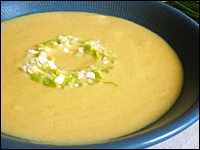
Cold Velvet Corn Soup
 Enlarge
This soup is so luxuriously satiny, you don't need any additional cream, half-and-half, buttermilk or anything else to smooth it out. The corn blends with the stock and gives it an astonishing sweetness, without added sugar.
Makes 4 to 6 servings
6 ears of fresh corn, husked (don't snap off the stalk — you'll need it as a handle)
2 leeks, white parts only
4 cups vegetable or light chicken stock
1 clove garlic
1 bay leaf
Salt and pepper to taste
Chopped scallions or chives for garnish (optional)
Rub the husked ears of corn with a towel to remove the last silk threads. Grasping the stalk end, hold the cob pointing straight down in a large mixing bowl and cut off the kernels with a sharp knife. Set the kernels aside. Break the cobs in half and place them in a stockpot.
Halve the white part of the leeks lengthwise. Rinse them, peeling back the layers to get at any sand trapped between them. Chop them coarsely and add them to the stockpot with all of the remaining ingredients except the corn kernels. Add a little salt to taste. Bring it to a boil and simmer for 25 minutes.
Remove cobs and bay leaf and discard. Taste the stock for seasoning. Then add corn kernels and simmer an additional 5 minutes. Using a blender set on high, puree the soup in batches and strain it through a fine strainer or sieve, discarding any fibrous solids. Chill at least 4 hours.
Cool Mixed Berry Soup
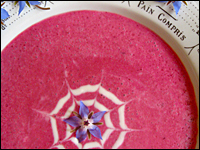
This is what my 2-year-old daughter calls "pink soup." Cold berry soups are often made with orange juice, but I prefer cranberry for color and tartness. Naturally sweetened cranberry juice tends to be less toothache-sweet than the high-fructose corn syrup variety. Choose red fruit for a brilliant rosy color, or add blueberries if you like it more purply. This is the soup version of a smoothie, so it's not terribly filling. But it really hits the spot when it's beastly hot outside. Plus, you don't have to turn on the stove even once.
Makes 4 servings
3 cups mixed fresh or frozen berries (raspberries, strawberries and/or blueberries work well)
1 cup cranberry juice (naturally sweetened if possible)
1 cup whole or low-fat yogurt
Juice of 1/2 lemon
1 to 2 tablespoons honey, to taste
A dollop or two of sour cream or creme fraiche for garnish (optional)
In a blender set at high speed, whiz the berries and juice together until you achieve a smooth puree. If you're using frozen berries the puree will be rather slushy. You'll need to stop and scrape down the sides of the blender periodically with a rubber spatula.
Strain the puree to remove any berry seeds or fibers. Place the puree back in the blender and add the yogurt, lemon and honey to taste. Serve with a dollop of sour cream or creme fraiche (or if you really feel like living large, put some sour cream, yogurt or creme fraiche in a squeeze bottle and do what those prep cooks in fancy restaurants do: Make some spirals or dots of cream and then drag a toothpick through them for spectacular effects).
Chilled Roasted Tomato Soup
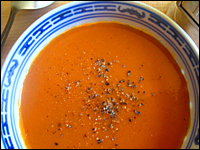
This is a great solution for the too-many-tomatoes problem some of us have in mid-August. If you don't feel like firing up the grill just to make a soup, then grill the vegetables when you're grilling something else. You can hold them, peeled and covered, for a day or two in the fridge. The rest of the soup is easy.
Makes 4 servings
2 pounds ripe tomatoes
1 red bell pepper
1/4 cup olive oil
1 onion, chopped medium
3 garlic cloves, coarsely chopped
1 cup chicken or vegetable stock
Salt and pepper
Preheat a gas grill, or start some coals for a charcoal grill. While the grill is heating, cut a slice off the top and the bottom of the red pepper and reserve. Cut the pepper open; remove the membrane and seeds. Flatten the pepper into one wide strip as best you can.
Remove any tomato stems.
When the grill is hot, place the whole tomatoes and the pepper pieces, including the top and bottom, over the hottest part of the grate. Grill, turning frequently, until they're blackened and blistering on all sides. As they finish, transfer them carefully to a medium-size mixing bowl. Let them rest, covering the bowl with a lid or plate, for 15 minutes or until they're cool enough to handle.
While the tomato and pepper are cooling, place the oil, onion, garlic and a little salt to taste in a heavy pot. Turn the heat to low, cover and sweat for about 25 minutes. Stir a few times to keep them from browning. When they're done, the onions will be translucent and will have given off quite a bit of liquid.
While the onions are sweating, peel the tomato and pepper (discarding any remaining stems) and coarsely chop them. After the onions are done sweating, raise the heat, add the red vegetables and saute over high heat for 5 minutes. Add the stock and simmer an additional 5 minutes.
Using a blender set on high, puree the soup in batches and strain through a fine strainer or sieve, discarding any fibrous solids.
Chill at least 4 hours.
Cool Zucchini Soup
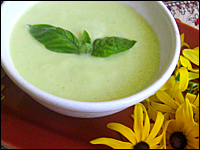
This is a very satisfying version of the zucchini-mint soup I so enjoyed. I've never quite figured out how to add the flavor of the mint while still preserving the smooth texture. I'm still working on it. But using mint as a fine herbal garnish works well, as does using basil.
Makes 4 servings
1/4 cup olive oil
2 small to medium zucchini, coarsely chopped
1 onion, coarsely chopped
Zest of 1 lemon
1 cup chicken or vegetable stock
1/4 to 1/2 cup buttermilk, to taste
Salt and pepper
Basil or mint sprigs, finely chopped or julienned, for garnish (optional)
Place the oil in a heavy pot. Add zucchini, onion, lemon zest and a little salt to help draw out the juices. Sweat them, covered, for 25 minutes. Check and stir frequently. Don't let the zucchini brown. Don't overcook it, either, or it will take on an unappetizing olive hue.
When the vegetables are quite tender but not mushy, add the stock. Simmer everything together for 5 minutes.
Using a blender set on high, puree the soup in batches and strain it through a fine strainer or sieve, discarding any fibrous solids. Whisk in buttermilk to taste and chill at least 4 hours.
Delicacies From 'Beyond The Great Wall'
Delicacies From 'Beyond The Great Wall', August 3, 2008 · Deep-fried cheese, crepes and carrot salad don't sound like Chinese food. But they are.
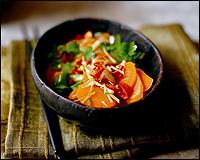
Fried cheese momos are a standard snack in Tibet, two-layer crepes are eaten by the Hui people in Qinghai province, and dai carrot salad is from the southern Yunnan city of Jinghong.
These are some of the foods of the 55 tribal groups called "minority peoples" by the Beijing government. These tribes make up 8 percent of China's population, which amounts to more than 100 million people.
Although these communities are not ethnically Chinese, they have lived on land that is now part of China for centuries. This includes Inner Mongolia, the western Silk Road region of Xinjiang and other lands outside central China's westernized cities like Beijing and Shanghai.
Jeffrey Alford and his wife, Naomi Duguid, first traveled widely in these areas in the 1980s, when China opened its borders to outside visitors. When they returned in 2005, they say, they were startled by the changes.
Alford and Duguid say they are worried that the tribal cultures are in danger of disappearing as China explodes economically and more Han Chinese in coastal cities relocate into these interior regions.
Their new book, Beyond the Great Wall: Recipes and Travels in the Other China, tells the story of China's minorities through a gorgeous blend of photography, travelogues and recipes.
Alford says the recipes featured in the book are easy for North American cooks to prepare because they probably have all the necessary equipment in their kitchens. Mix that with ingredients easily found in local markets, and you're prepared to experience delicacies from the farthest reaches of China.
Courtesy of Artisan Books © 2008
Fried cheese momos are a standard snack in Tibet, two-layer crepes are eaten by the Hui people in Qinghai province, and dai carrot salad is from the southern Yunnan city of Jinghong.
These are some of the foods of the 55 tribal groups called "minority peoples" by the Beijing government. These tribes make up 8 percent of China's population, which amounts to more than 100 million people.
Although these communities are not ethnically Chinese, they have lived on land that is now part of China for centuries. This includes Inner Mongolia, the western Silk Road region of Xinjiang and other lands outside central China's westernized cities like Beijing and Shanghai.
Jeffrey Alford and his wife, Naomi Duguid, first traveled widely in these areas in the 1980s, when China opened its borders to outside visitors. When they returned in 2005, they say, they were startled by the changes.
Alford and Duguid say they are worried that the tribal cultures are in danger of disappearing as China explodes economically and more Han Chinese in coastal cities relocate into these interior regions.
Their new book, Beyond the Great Wall: Recipes and Travels in the Other China, tells the story of China's minorities through a gorgeous blend of photography, travelogues and recipes.
Alford says the recipes featured in the book are easy for North American cooks to prepare because they probably have all the necessary equipment in their kitchens. Mix that with ingredients easily found in local markets, and you're prepared to experience delicacies from the farthest reaches of China.
Excerpt: 'Beyond The Great Wall'
Courtesy of Artisan Books © 2008
NPR.org, August 1, 2008 ·
Dai Carrot Salad
This dish is one of an incredible variety of prepared foods available at the markets in the small city of Jinghong in southern Yunnan province. Makes 4 salad or appetizer servings.
Ingredients:
1 pound large carrots
2 tablespoons pickled chiles, cut into ½-inch slices
3 scallions, smashed and sliced into ½-inch lengths
1 tablespoon soy sauce
1 tablespoon rice vinegar
1 teaspoon roasted sesame oil
½ teaspoon salt, or to taste.
2-3 tablespoons coriander leaves, coarsely chopped
Directions:
Peel the carrots. Slice very thin, 1/8-inch thick if possible, on a 45-degree angle. You should have 3 cups.
In a medium saucepan, bring 4 cups of water to a boil. Toss in the carrot slices and stir to separate them. Cook just until slightly softened and no longer raw, about 3 minutes. Drain.
Transfer the carrots to a bowl and let cool slightly, then add the chiles and scallion ribbons and toss to mix.
Whisk together the soy sauce, rice vinegar and sesame oil. Pour over the salad while the carrots are still warm. Stir or toss gently to distribute the dressing, then turn the salad out onto a serving plate or into a wide shallow bowl.
Serve the salad warm or at room temperature. Just before serving, sprinkle on the salt and toss gently, then sprinkle on the coriander and toss again.
Cheese Momos
Cheese made from yak milk is a staple in many parts of Tibet.
Makes 16 half-moon filled breads
Ingredients:
Dough:
1 ½ cups all-purpose flour, preferably unbleached, plus extra for surfaces
½ teaspoon salt
About ½ cup lukewarm water
Filling:
¼ pound dry-textured goat's-milk feta or Pecorino-Romano, crumbled or minced (1 packed cup)
¼ cup minced scallions (white and tender green parts)
Peanut oil for deep-frying (2-4 cups)
Directions:
Place the flour and salt in a food processor and pulse briefly to mix. With the blade running, slowly add the water through the feed tube until a ball forms. Turn out onto a lightly floured surface and knead briefly. The dough should be soft and elastic. Cover with plastic wrap and set aside to rest for 30 minutes to 2 hours, whatever is most convenient.
Mix together cheese and scallions in medium bowl. Set aside.
Cut the dough in half. Set one half aside, covered. On a lightly floured surface, shape the other half into a cylinder by rolling it under your palms. Cut the cylinder crosswise in half, then in half and half again, to give you 8 equal pieces. Work with one piece at a time, leaving the others loosely covered with plastic wrap.
On the lightly floured surface, roll one piece out to a nearly 5-inch round. Place 1 packed tablespoon of the cheese mixture in the center of the round and fold over to make a half-moon shape. Press down lightly with a floured palm, to get rid of air bubbles, then pleat the edges closed. Start at one end and pinch the edges together between thumb and forefinger, then twist the place over, rolling the edge. Move along about ¼ inch and repeat, then continue until the edge is completely sealed. If the dough is not sticking to itself, brush off excess flour and brush the edge with a very little water. Set aside on a lightly floured surface and repeat with the remaining 7 pieces of dough, and then with the remaining dough and cheese.
Place a large wok or deep heavy pot on stovetop, making sure it's stable. (Or use a deep-fryer.) Pour 2 inches of oil into the wok or pot and heat over high heat. To check temperature of the oil, hold a wooden chopstick vertically in the oil, with the end touching the bottom of the pot. If bubbles bubble up along the chopstick, the oil is the right temperature. The oil should not be smoking.
When the oil is ready, slide one momo into the hot oil. Add another, and repeat until you have 4 frying at once. If pot is small, stop before pot is crowded. Use a slotted spoon or wire skimmer to move the momos around and gently turn them. They will quickly turn golden brown with darker brown bubbled spots.
After 1-2 minutes, when they are a rich golden brown and crisped looking, use the slotted spoon or skimmer to transfer to a rack or plate lined with paper towels. Repeat with the remaining momos.
Serve hot.
Calif. Winemaker Offers Personalized Vines
Calif. Winemaker Offers Personalized Vines, July 24, 2008 · Steve Inskeep has today's Last Word in business.
French Winery To Buy Napa's Chateau Montelena
French Winery To Buy Napa's Chateau Montelena, July 24, 2008 · A legendary French winery is purchasing a famous winemaker in California. The deal comes decades after the same California winery beat French wines in a blind taste test.
Deborah Amos talks to Vic Motto, a wine industry investment banker, about the deal. Motto says it's "a very important merger of two great wine estates."
Deborah Amos talks to Vic Motto, a wine industry investment banker, about the deal. Motto says it's "a very important merger of two great wine estates."
Italy Relents On Boxed Wine (From NPR)
Italy Relents On Boxed Wine, August 5, 2008 · Italy has said it will now allow wine in a box. Ray Isle, deputy wine editor for Food and Wine Magazine, says the change came when Italians realized they couldn't compete in the global market without changing traditional restrictions on regional wines.
2008年8月7日 星期四
Electronic wine-tasting tongue tests grape variety and vintage (From gizmag)
August 6, 2008 Could this new electronic wine-tastingBeer-Wine-Industry-Parallels  tonguehttp://en.wikipedia.org/wiki/Tongue challenge the finest wine tasters in the world? Invented by European scientists, this handheld device has a multi-sensor chip which senses distinctive characteristics of wine varieties. By analyzing the sugar content, acidity and alcohol, the machine can also determine the year and grape variety of the sample and instead of waiting days for laboratories to analyze wine samples, wine industry specialists will be able to get a sample result at the touch of a button.
Invented by Cecilia Jiménez-Jorquera and colleagues from the Barcelona Institute of Microelectronics, Spain, this handheld device has a multi-sensor chip which senses distinctive characteristics of wine varieties.
“the device could be used to detect frauds committed regarding the vintage year of the wine, or the grape varieties used,” according to Jiménez-Jorquera. The wine-tasting tongue is portable, cheap to manufacture, is capable of being programmed to test for other parameters and can be trained to test new varietals.
Via The Analyst.
2008年8月6日 星期三
Savoring The Spice In Kung Pao Chicken (From NPR)
All Things Considered, August 6, 2008 · When we decided to do a week of All Things Considered broadcasts from Chengdu, China, in May, little did we imagine that we'd find ourselves covering an 8.0 magnitude earthquake. The earthquake hit the day after I arrived in Chengdu.
I had been in Chengdu in April, gathering material for stories to air the next month. I had planned to do one story a day on the food of Sichuan, which is justly famous and utterly delicious
Naturally, the earthquake put those stories on hold.
Now, here's one of those stories, from a day I spent at The Sichuan Higher Institute of Cuisine in April. It's a prestigious cooking school in Chengdu that is training the next generation of chefs. The school reopened just a couple of days after the earthquake.
The Lure Of Sichuan Food
Sichuan food is famous for its mouth-numbing, spicy heat. And in the time I spent in Chengdu, I grew especially intrigued by a singular Sichuan sensation: ma.
Ma means "numbing" in Chinese, and that numbing sensation is a distinctive characteristic of Sichuan food. It comes from the Sichuan peppercorn, hua jiao, which translates to "flower pepper."
These peppercorns are not to be confused with hot red chili peppers. In fact, the Sichuan peppercorn isn't a pepper at all. It's an aromatic berry from the prickly ash tree.
When they're dried, the peppercorns turn a beautiful purple, and they're used with abandon in many dishes.
And there's another use: I've learned that you can put a peppercorn in your mouth to numb a toothache.
That was one lesson among many I learned during the day I spent at the Sichuan Higher Institute of Cuisine.
Layers Of Flavor
My teacher at the school, Li Jianqing, challenged me to bite into a Sichuan peppercorn. He told me a Swiss visitor had tried, but couldn't handle it.
Well, I couldn't resist that challenge, so I popped a peppercorn into my mouth and chomped down hard. Right away, my tongue started to tingle. Then, the sensation spread. My mouth started buzzing, dancing with a fizzy heat. The tingling moved from my tongue to my lips — it was a good tingling, not painful. Bit by bit, the taste filled my mouth — fragrant and a little bit sour.
Then, we got down to business. Li gave me a cooking demonstration, expertly stir-frying a wokful of a classic Sichuan dish: Kung Pao chicken, or chicken with peanuts, flavored with hot chilies and Sichuan pepper.
Before I left for Chengdu, the food writer Fuchsia Dunlop told me I had to eat Kung Pao chicken there. She said it would taste totally different from the dish I'd eaten many times in Chinese restaurants in the U.S.
And she was right. When I sampled Li's Kung Pao chicken, it had layers of flavor I had never tasted before.
My Turn To Sweat
Then Li challenged me again: "Can you do this dish?"
There's only one answer to that.
So, I put on a white chef's hat and got to work on the Kung Pao chicken. First, I mixed up the sauce — black vinegar, soy sauce, salt and sugar, mixed with corn starch and water — and poured it over the diced chicken. Li turned the gas on under the wok, and the flame roared up fiercely around it.
I tossed the chicken in the wok and started stir-frying, maybe a bit too energetically.
"Relax!" Li told me. Easy for him to say.
It turns out, stir-frying in a mock professional kitchen is harder than it looks. The wok was heavy and seemed huge. I held one handle with my left hand, which was wrapped in a towel to protect it from the heat. But it was an awkward grip, and when it came time to slide the chicken out of the wok, I lost some in the process.
Into the wok went hot chilies and those famous Sichuan peppercorns. Then, ginger, garlic and scallions. Last, I dumped the chicken back in, stir-fried it all together, and that was it.
Finally, the moment of truth. Li took a bite.
"It's very good," he said. "It's better than mine."
But I knew he was just being kind to a visitor. And he was too polite to mention that I had burned the chilies.
I had been in Chengdu in April, gathering material for stories to air the next month. I had planned to do one story a day on the food of Sichuan, which is justly famous and utterly delicious
Naturally, the earthquake put those stories on hold.
Now, here's one of those stories, from a day I spent at The Sichuan Higher Institute of Cuisine in April. It's a prestigious cooking school in Chengdu that is training the next generation of chefs. The school reopened just a couple of days after the earthquake.
The Lure Of Sichuan Food
Sichuan food is famous for its mouth-numbing, spicy heat. And in the time I spent in Chengdu, I grew especially intrigued by a singular Sichuan sensation: ma.
Ma means "numbing" in Chinese, and that numbing sensation is a distinctive characteristic of Sichuan food. It comes from the Sichuan peppercorn, hua jiao, which translates to "flower pepper."
These peppercorns are not to be confused with hot red chili peppers. In fact, the Sichuan peppercorn isn't a pepper at all. It's an aromatic berry from the prickly ash tree.
When they're dried, the peppercorns turn a beautiful purple, and they're used with abandon in many dishes.
And there's another use: I've learned that you can put a peppercorn in your mouth to numb a toothache.
That was one lesson among many I learned during the day I spent at the Sichuan Higher Institute of Cuisine.
Layers Of Flavor
My teacher at the school, Li Jianqing, challenged me to bite into a Sichuan peppercorn. He told me a Swiss visitor had tried, but couldn't handle it.
Well, I couldn't resist that challenge, so I popped a peppercorn into my mouth and chomped down hard. Right away, my tongue started to tingle. Then, the sensation spread. My mouth started buzzing, dancing with a fizzy heat. The tingling moved from my tongue to my lips — it was a good tingling, not painful. Bit by bit, the taste filled my mouth — fragrant and a little bit sour.
Then, we got down to business. Li gave me a cooking demonstration, expertly stir-frying a wokful of a classic Sichuan dish: Kung Pao chicken, or chicken with peanuts, flavored with hot chilies and Sichuan pepper.
Before I left for Chengdu, the food writer Fuchsia Dunlop told me I had to eat Kung Pao chicken there. She said it would taste totally different from the dish I'd eaten many times in Chinese restaurants in the U.S.
And she was right. When I sampled Li's Kung Pao chicken, it had layers of flavor I had never tasted before.
My Turn To Sweat
Then Li challenged me again: "Can you do this dish?"
There's only one answer to that.
So, I put on a white chef's hat and got to work on the Kung Pao chicken. First, I mixed up the sauce — black vinegar, soy sauce, salt and sugar, mixed with corn starch and water — and poured it over the diced chicken. Li turned the gas on under the wok, and the flame roared up fiercely around it.
I tossed the chicken in the wok and started stir-frying, maybe a bit too energetically.
"Relax!" Li told me. Easy for him to say.
It turns out, stir-frying in a mock professional kitchen is harder than it looks. The wok was heavy and seemed huge. I held one handle with my left hand, which was wrapped in a towel to protect it from the heat. But it was an awkward grip, and when it came time to slide the chicken out of the wok, I lost some in the process.
Into the wok went hot chilies and those famous Sichuan peppercorns. Then, ginger, garlic and scallions. Last, I dumped the chicken back in, stir-fried it all together, and that was it.
Finally, the moment of truth. Li took a bite.
"It's very good," he said. "It's better than mine."
But I knew he was just being kind to a visitor. And he was too polite to mention that I had burned the chilies.
Gong Bao (Kung Pao) Chicken with Peanuts
(Gong Bao Ji Ding)
NPR.org, May 2, 2008 · This dish, also known as Kung Pao chicken, has the curious distinction of having been labeled as politically incorrect during the Cultural Revolution. It is named after a late Qing Dynasty (late nineteenth century) governor of Sichuan, Ding Baozhen, who is said to have particularly enjoyed eating it — gong bao was his official title. No one can quite agree on the details of its origins: some say it was a dish Ding Baozhen brought with him from his home province of Guizhou; others that he ate it in a modest restaurant when he went out in humble dress to observe the real lives of his subjects; still others, rather implausibly, that his chef invented the finely chopped chicken dish because Ding Baozhen had bad teeth. Whatever the truth of its origins, its association with an imperial bureaucrat was enough to provoke the wrath of the Cultural Revolution radicals, and it was renamed "fast-fried chicken cubes" (hong bao ji ding) or "chicken cubes with seared chiles" (hu la ji ding) until its political rehabilitation in the 1980s.
Gong Bao chicken is beautiful to look at: a glorious medley of chicken flesh, golden peanuts and bright red chiles. The sauce is based on a light sweet-and-sour, pepped up with a deep chile spiciness and a trace of Sichuan pepper that will make your lips tingle pleasantly. The ingredients are all cut in harmony, the chicken in small cubes and the scallion in short pieces to complement the peanuts. The chicken should be just cooked and wonderfully succulent; the nuts are added at the very last minute so they keep their crispness.
Serves 2 as a main dish with a simple stir-fried vegetable and rice, 4 as part of a Chinese meal with three other dishes
2 boneless chicken breasts, with or without skin (about 2/3 pound total)
3 cloves of garlic and an equivalent amount of fresh ginger
5 scallions, white parts only
2 tablespoons peanut oil
a generous handful of dried red chiles (at least 10), preferably Sichuanese
1 teaspoon whole Sichuan pepper
2/3 cup roasted unsalted peanuts
For the marinade:
1/2 teaspoon salt
2 teaspoons light soy sauce
1 teaspoon Shaoxing rice wine or medium-dry sherry
1 1/2 teaspoons potato flour or 2 1/4 teaspoons cornstarch
1 tablespoon water
For the sauce:
3 teaspoons sugar
3/4 teaspoon potato flour or 1 1/8 teaspoons cornstarch
1 teaspoon dark soy sauce
1 teaspoon light soy sauce
3 teaspoons Chinkiang or black Chinese vinegar
1 teaspoon sesame oil
1 tablespoon chicken stock or water
1. Cut the chicken as evenly as possible into 1/2-inch strips and then cut these into small cubes. Place in a small bowl and mix in the marinade ingredients.
2. Peel and thinly slice the garlic and ginger, and chop the scallions into chunks as long as their diameter (to match the chicken cubes). Snip the chiles in half or into 2-inch sections. Wearing rubber gloves, discard as many seeds as possible.
3. Combine the sauce ingredients in a small bowl — if you dip your finger in, you can taste the sweet-sour base of the gong bao flavor.
4. Season the wok, then add 2 tablespoons of oil and heat over a high flame. When the oil is hot but not yet smoking, add the chiles and Sichuan pepper and stir-fry briefly until they are crisp and the oil is spicy and fragrant. Take care not to burn the spices (you can remove the wok from the heat if necessary to prevent overheating).
5. Quickly add the chicken and fry over a high flame, stirring constantly. As soon as the chicken cubes have separated, add the ginger, garlic, and scallions and continue to stir-fry for a few minutes until they are fragrant and the meat is cooked through (test one of the larger pieces to make sure).
6. Give the sauce a stir and add it to the wok, continuing to stir and toss. As soon as the sauce has become thick and shiny, add the peanuts, stir them in, and serve.
Variations
The same dish can be made with cubes of pork, shrimp, or prawns.
Cashew nuts can be used instead of peanuts for a grander version of this dish, although peanuts are more traditional.
Reprinted from Land of Plenty: Authentic Sichuan Recipes Personally Gathered in the Chinese Province of Sichuan by Fuchsia Dunlop. Copyright (c) 2001 by Fuchsia Dunlop. With permission from the publisher, W.W. Norton & Company, Inc.
2008年8月5日 星期二
This week's food and wine events
The Guide: This week's food and wine events
Wine tastings, a tea lunch and more....
August 6, 2008
TODAY
Wine tasting at Maison 140:Vintner Brian Graham of Napa's Ramian Estate will be on hand to discuss and pour at the tasting. The wines, including a 2007 Viognier and a 2005 Rhône blend, will be paired with artisanal cheeses from Froma on Melrose. 6 p.m., 140 S. Lasky Drive, Beverly Hills, (310) 281-4000; www.maison140beverlyhills.com. $25.
THURSDAY
Wine & jazz dinner at Citrus at Social:Seth Kunin of the Santa Ynez Valley's Westerly Wines hosts a wine dinner at Citrus, one of a series of pre-harvest wine and jazz dinners held each Thursday in August. Price includes a talk by the winemaker, a five-course meal with wine pairings, live jazz, valet, tax and gratuity. 7 to 9 p.m., 6525 Sunset Blvd. L.A., (323) 337-9797; www.citrusatsocial.com. $125.
FRIDAY
Tea lunch at Jin Patisserie:Enjoy a two-course savory-and-sweet-themed tea lunch created by assistant pastry chef Annabel Ho. Melange O and Ceylon O.P. Superior teas will complement a menu that includes dishes such as prosciutto avocado sandwiches and coconut banana chocolate cake. Noon to 5 p.m., 1202 Abbot Kinney Blvd., Venice, (310) 399-8801; www.jinpatisserie.com. $28.
SATURDAY
Fruit tasting at Kellogg Ranch:The Dave Wilson Nursery hosts a free public fruit tasting that will be filmed for the television show " California Country." Expect all kinds of fruit including peaches, nectarines, apples and plums. 1 to 3 p.m., 4102 S. University Drive, Pomona, (800) 654-5854; www.davewilson.com. Free.
Paso Robles winemakers cook-off:Taste the creations of more than 20 Paso Robles winemaker-chefs in a cook-off competition that culminates with the pairing of grilled foods with their finest wines. Judges and the public pick the winners; there will be live music. Proceeds benefit the Rotary's college scholarship fund. 6 to 9 p.m., River Oaks Hot Springs Spa, 800 Clubhouse Drive, Paso Robles, (877) 686-8564; winemakerscookoff.com. $75.
Wine tastings, a tea lunch and more....
August 6, 2008
TODAY
Wine tasting at Maison 140:Vintner Brian Graham of Napa's Ramian Estate will be on hand to discuss and pour at the tasting. The wines, including a 2007 Viognier and a 2005 Rhône blend, will be paired with artisanal cheeses from Froma on Melrose. 6 p.m., 140 S. Lasky Drive, Beverly Hills, (310) 281-4000; www.maison140beverlyhills.com. $25.
THURSDAY
Wine & jazz dinner at Citrus at Social:Seth Kunin of the Santa Ynez Valley's Westerly Wines hosts a wine dinner at Citrus, one of a series of pre-harvest wine and jazz dinners held each Thursday in August. Price includes a talk by the winemaker, a five-course meal with wine pairings, live jazz, valet, tax and gratuity. 7 to 9 p.m., 6525 Sunset Blvd. L.A., (323) 337-9797; www.citrusatsocial.com. $125.
FRIDAY
Tea lunch at Jin Patisserie:Enjoy a two-course savory-and-sweet-themed tea lunch created by assistant pastry chef Annabel Ho. Melange O and Ceylon O.P. Superior teas will complement a menu that includes dishes such as prosciutto avocado sandwiches and coconut banana chocolate cake. Noon to 5 p.m., 1202 Abbot Kinney Blvd., Venice, (310) 399-8801; www.jinpatisserie.com. $28.
SATURDAY
Fruit tasting at Kellogg Ranch:The Dave Wilson Nursery hosts a free public fruit tasting that will be filmed for the television show " California Country." Expect all kinds of fruit including peaches, nectarines, apples and plums. 1 to 3 p.m., 4102 S. University Drive, Pomona, (800) 654-5854; www.davewilson.com. Free.
Paso Robles winemakers cook-off:Taste the creations of more than 20 Paso Robles winemaker-chefs in a cook-off competition that culminates with the pairing of grilled foods with their finest wines. Judges and the public pick the winners; there will be live music. Proceeds benefit the Rotary's college scholarship fund. 6 to 9 p.m., River Oaks Hot Springs Spa, 800 Clubhouse Drive, Paso Robles, (877) 686-8564; winemakerscookoff.com. $75.
Why Midori?
Why Midori?
Midori is a common cocktail ingredient (Picture by Sam Smith)Microsoft's new operating system research project is mysteriously named "Midori". But why?
Coining the codenames for consumer tech products can be a tricky business.
If your project was designing a new way of coupling articulated lorries or maximising efficiency in polymer production, you wouldn't have to worry too much about the working title.
But if you are Microsoft or Apple or one of the other consumer electronics giants, your most embryonic of projects can garner significant worldwide coverage.
And when it's being discussed in forums and blogs, a massive potential source of free advertising, even the codename must sit right with the product. Normally the names are unusual enough to stand out, without ever risking any negative connotations.
CHOICE CODENAMES
Hailstorm
Indigo
Pinball
Frosting - Another word for icing
Godot - Delayed project
Thus it seems slightly strange that Microsoft has chosen the word "midori" for its latest research project. It's an effort to create an internet-based system for a world where people use more than one machine to access applications, and it's already being talked about.
Japanese word
Some people's first thought will be of Midori, the super-sweet green Japanese melon-flavoured cocktail liqueur that claims to be "refreshingly different". It's the key ingredient in the Green Alien, the Japanese Slipper, and the extraordinarily named Giraffe Snot (blue curacao, Midori, cranberry juice, passionfruit pulp).
Midori is also the Japanese word for green, so you might imagine the designers having an environmental moment. But in Japanese, midori does not have quite the same idiomatic sense as the way English-speakers use "green". There is a green day, midorinohi, on 29 April, Emperor Hirohito's birthday, but it celebrates "greenery" and the planting of trees more than wider environmental concerns.
There is a fashion designer called Midori
Midori crops up in Japanese placenames, and it is a relatively common girl's name. Here's where it becomes connotation-laden. Midori is a Japanese violinist, but another Midori is a "prominent human sexuality writer" and a third Midori is a porn actress. There is a Midori Snyder who writes fantasy novels, and a Midori Matsuo who is an aspirant underwear designer.
And most bizarrely, the codename midori has already apparently been used in the technology field with a version of Linux and a WebKit browser.
It's all a big departure for a company that usually just sticks with placenames.
"Many of the Microsoft ones are named after mountains," says Dan Grabham, computing editor of techradar.com. Chip firm Intel also goes for American placenames, he notes.
"If they choose a placename it is quite easy to remember, if it was just a number that might get confused. I haven't come across where Midori is from. I would have guessed it was the Japanese connection."
Microsoft has had a particular fascination for the ski resort of Whistler Blackcomb where it held "design retreats".
The project codenamed Whistler became Windows XP, Longhorn, named after a bar in Whistler, became Windows Vista, and the next generation of Windows was codenamed Blackcomb, although that changed to Vienna and more recently to Windows 7.
Other Whistler-related codenames include Bobcat, Freestyle, Harmony, Cougar, Symphony, Emerald, and Springboard, variously the names, of ski lifts, ski runs and "alpine bowls".
The codenames can give a hint of the ethos of the people behind the product.
Each version of the Ubuntu Linux system carries, as well as a number, a name. So far they have included Breezy Badger, Feisty Fawn and Gutsy Gibbon.
But exactly what Midori is really saying remains unclear.
Midori is a common cocktail ingredient (Picture by Sam Smith)Microsoft's new operating system research project is mysteriously named "Midori". But why?
Coining the codenames for consumer tech products can be a tricky business.
If your project was designing a new way of coupling articulated lorries or maximising efficiency in polymer production, you wouldn't have to worry too much about the working title.
But if you are Microsoft or Apple or one of the other consumer electronics giants, your most embryonic of projects can garner significant worldwide coverage.
And when it's being discussed in forums and blogs, a massive potential source of free advertising, even the codename must sit right with the product. Normally the names are unusual enough to stand out, without ever risking any negative connotations.
CHOICE CODENAMES
Hailstorm
Indigo
Pinball
Frosting - Another word for icing
Godot - Delayed project
Thus it seems slightly strange that Microsoft has chosen the word "midori" for its latest research project. It's an effort to create an internet-based system for a world where people use more than one machine to access applications, and it's already being talked about.
Japanese word
Some people's first thought will be of Midori, the super-sweet green Japanese melon-flavoured cocktail liqueur that claims to be "refreshingly different". It's the key ingredient in the Green Alien, the Japanese Slipper, and the extraordinarily named Giraffe Snot (blue curacao, Midori, cranberry juice, passionfruit pulp).
Midori is also the Japanese word for green, so you might imagine the designers having an environmental moment. But in Japanese, midori does not have quite the same idiomatic sense as the way English-speakers use "green". There is a green day, midorinohi, on 29 April, Emperor Hirohito's birthday, but it celebrates "greenery" and the planting of trees more than wider environmental concerns.
There is a fashion designer called Midori
Midori crops up in Japanese placenames, and it is a relatively common girl's name. Here's where it becomes connotation-laden. Midori is a Japanese violinist, but another Midori is a "prominent human sexuality writer" and a third Midori is a porn actress. There is a Midori Snyder who writes fantasy novels, and a Midori Matsuo who is an aspirant underwear designer.
And most bizarrely, the codename midori has already apparently been used in the technology field with a version of Linux and a WebKit browser.
It's all a big departure for a company that usually just sticks with placenames.
"Many of the Microsoft ones are named after mountains," says Dan Grabham, computing editor of techradar.com. Chip firm Intel also goes for American placenames, he notes.
"If they choose a placename it is quite easy to remember, if it was just a number that might get confused. I haven't come across where Midori is from. I would have guessed it was the Japanese connection."
Microsoft has had a particular fascination for the ski resort of Whistler Blackcomb where it held "design retreats".
The project codenamed Whistler became Windows XP, Longhorn, named after a bar in Whistler, became Windows Vista, and the next generation of Windows was codenamed Blackcomb, although that changed to Vienna and more recently to Windows 7.
Other Whistler-related codenames include Bobcat, Freestyle, Harmony, Cougar, Symphony, Emerald, and Springboard, variously the names, of ski lifts, ski runs and "alpine bowls".
The codenames can give a hint of the ethos of the people behind the product.
Each version of the Ubuntu Linux system carries, as well as a number, a name. So far they have included Breezy Badger, Feisty Fawn and Gutsy Gibbon.
But exactly what Midori is really saying remains unclear.
2008年8月4日 星期一
The art of Sandwich-Making
The art of Sandwich-Making
July 30, 2008 · In theory, a perfectly balanced meal includes some protein, but not too much; a vegetable or two; some fruit and a carbohydrate. Such a meal also should balance tastes — savory, a little sour or bitter maybe, perhaps some sweet and salt — and textures, from chewy to succulent to crisp. Let's go a step further and propose that this meal also can conveniently be eaten while playing cards.
According to popular legend, the sandwich was invented by John Montagu, the fourth Earl of Sandwich, who, while gambling, told his butler to put some meat between two slices of bread so he could eat without interrupting the game and getting grease on the cards. Although the tale is almost certainly apocryphal (I figure the first sandwich was made the day after bread was invented), apparently the earl did lend his name to this gustatory delight.
At its simplest, a sandwich is two slices of bread enclosing a filling. It also is often a perfectly balanced meal, consisting of protein, vegetable, carbohydrate, often dairy and even fruit. My definition is somewhat broader: A sandwich is a filling enclosed in bread or pastry that can be eaten by hand.
That definition leaves out such things as open-faced roast beef or turkey sandwiches smothered in gravy that must be eaten with a knife and fork. And although most burgers qualify, my favorite burger at my favorite diner is out because the thing is just too big to wield by hand. I ultimately resort to cutlery.
My definition includes such things as wraps, tacos, Cornish pasties, empanadas and stuffed pitas — all of which can be held in one hand while playing cards.
A few genuine sandwiches can be problematic. A proper Philly cheese steak requires two hands to eat, as does a Chicago Italian beef sandwich. Both also require a proper stance (standing, legs spread, leaning forward) to eat if you want to avoid dripping on your shirt or splattering on your pants. This makes playing cards at the same time difficult, although not impossible. Cutting the sandwiches in half and wrapping them in foil helps.
All the world loves a sandwich. Some sandwiches, such as the Cubano and the muffaletta, are associated with particular cities (Miami and New Orleans, respectively). Others, such as the Cuban pastelitos de carne or the Chilean barros luco, are associated with entire nations.
Wherever a sandwich is from, though, its foundation, its most important single element, is the bread. Great bread can elevate great ingredients to new heights. Bad bread can make even the finest fillings ho-hum.
I was once asked what is the longest time I have ever spent on a sandwich. My answer was over 38 hours. I had an urge for a ham and cheese panini, and I began by reviving my chilled sourdough starter (12 hours). When the starter was once again bubbling away, I moved on to the poolish — a second fermentation phase lasting eight hours. Then I let the bread rise (four hours), formed it into a loaf and refrigerated it overnight (eight hours). Next, I let the loaf rise (four hours) and baked it (30 minutes), and let it cool (two hours). Then I cut two slices, brushed them with olive oil and added Black Forest ham, a bit of mustard and butterkase cheese before grilling the sandwich.
You don't have to bake your own bread; good bread is readily available. However, the bread should be the first consideration, not an afterthought.
None of the sandwiches below are quick, spur-of-the-moment affairs, but they are all worth the time. With a little care, they can be eaten with one hand while playing Texas Hold' em.
Muffaletta -
In the mid-19th century, an influx of Italian immigrants to New Orleans affected the city's cuisine in many ways — including the birth of the muffaletta sandwich. This amazing meal consists of ham, salami, mortadella, provolone and mozzarella served on an 8-inch loaf of round, flattened bread (typically half- and quarter-sandwiches also are available). I've never seen the bread anywhere else, but recipes are available on the Internet. A good Italian loaf or a Kaiser roll will also work. The astounding thing about this sandwich, though, is the olive mix. The pungent combination of pimento-stuffed olives, kalamata olives, Italian pickled vegetables, garlic and olive oil is spread on the bottom of the heap. Ideally, the sandwich should be made an hour or more in advance and then tightly wrapped in plastic to enable the juices to soak the bread.
Makes 4 servings
Sandwich
1 loaf Italian bread or 4 Kaiser rolls
1 cup olive mix (recipe below)
1/4 pound sliced smoked ham
1/4 pound sliced mortadella (Italian bologna. If you can't find it, skip it.)
1/4 pound sliced Genoa salami
1/4 pound sliced provolone
1/4 pound sliced mozzarella
Cut bread in half horizontally. Spread half with olive mix, then layer on meats and cheeses. Top with other half of bread. If using muffaletta or Italian bread, slice into quarters before serving.
Olive Mix-
A couple of years ago, a friend brought me a jar of olive mix from New Orleans' Central Grocery, the birthplace of the muffaletta, so I had an opportunity to compare the version I'd developed with the original. I use a bit more garlic and add lemon juice, which makes it slightly more tangy. My mix has been tested and approved by New Orleans natives.
Makes enough for 8 to 10 sandwiches
1 1/2 cups pimento-stuffed olives
1/2 cup pitted kalamata olives
1/2 cup giardiniera (Italian pickled vegetables, available in the pickle section of most supermarkets)
1/4 cup pepperoncini
1/4 cup pickled onions
1 tablespoon capers
2 large cloves garlic, minced
1 tablespoon fresh oregano
1/4 teaspoon ground pepper
1 tablespoon lemon juice
1/4 cup olive oil
Drain all ingredients. Place all ingredients in a food processor and pulse until coarsely chopped. For best results, refrigerate overnight to let flavors meld.
Mixture will keep for 6 months sealed in a glass jar in the refrigerator.
Cubano -
These panini-style sandwiches of citrus-braised pork, ham, salami and cheese are knock-dead delicious. Brushed with butter and then cooked on a grill pan, panini maker or even a griddle, the sandwiches are sold throughout Miami. It's the sliced pork that makes this sandwich special, but the additions of common ballpark mustard and dill sandwich pickles make it fun. As with the muffaletta, this sandwich is associated with a particular bread (you can find recipes for Cuban bread online), and I often bake the bread myself. A decent Italian bread also works. You will have to make the pork roast in advance.
Makes 8 sandwiches
Sandwich
Cooked citrus-braised pork roast, sliced
2 10-inch loaves Cuban bread or Italian bread
Yellow ballpark mustard
Butter
8 slices Swiss cheese
8 thin slices cooked ham
8 thin slices Genoa salami
Dill pickle slices (not kosher pickles)
Cut bread in half horizontally. Spread outsides of halves with butter and insides with yellow mustard. Add ham, salami, braised pork, cheese and pickles.
Heat a grill pan, panini maker or griddle to medium heat.
If you have a panini maker, press sandwich and cook until cheese melts.
If you're using a grill pan or griddle, press the sandwich with a baking sheet weighed down with a few canned goods. Turn the sandwich after about 7 minutes, and cook until browned.
Citrus-Braised Pork Roast
2-pound boneless pork shoulder
1/2 cup orange juice
1/4 cup lemon juice
1/4 cup lime juice
1/3 cup dark rum
1 teaspoon salt
1 teaspoon ground cumin
12 to 15 black peppercorns, cracked
3 large garlic cloves, crushed
Combine all ingredients in a zip-top bag and shake to mix. Marinate 24 hours, refrigerated, occasionally turning to make sure all sides of the meat are treated.
Heat oven to 325 degrees. Place roast in a Dutch oven and add marinade. Cover and cook for 3 hours, turning once or twice. If liquid gets too low, add some water.
When done, place on a cutting board, tented with foil, and allow to rest for 15 minutes. Cut in half and, exercising all of your willpower, set half aside for sandwiches tomorrow.
Banh Mi -
An example of the fusion of colonial French and traditional Vietnamese cuisines, this sandwich requires dedication — not to make it, but to eat it. The Vietnamese like things hot, and their chili garlic sauce is certainly that. In addition, sliced jalapeno or serrano peppers are often added. The sandwich consists of chicken, pork, shrimp or beef with pickled daikon and carrots, and cilantro and assorted lettuce greens on a French baguette.
Makes 4 sandwiches
Sandwich
1 16-inch French baguette
2 to 3 tablespoons chili garlic sauce (available in Asian food section of most markets)
2 roasted chicken breasts (I usually buy a cooked rotisserie chicken)
2 cups mixed baby greens
1 cup fresh cilantro leaves
1/2 cup sliced jalapeno or serrano peppers (optional)
Pickled Daikon and Carrots
1/4 cup rice vinegar
1/4 cup granulated sugar
1/4 teaspoon salt
1 8-inch daikon radish, peeled and cut into very thin strips
1 8-inch carrot, peeled and cut into very thin strips
Combine vinegar, sugar and salt in a bowl and whisk to dissolve sugar. Add daikon and carrot and marinate for 30 minutes.
Cut baguette in half horizontally. Spread bottom half with chili garlic sauce, top with remaining ingredients and cut crosswise into 4 sandwiches.
Shawarma -
The shawarma is a Middle Eastern version of the Greek gyro, made with chicken, turkey or lamb. In either sandwich, the meat is meltingly tender, partially because of the marinade and partially because it's presliced and then packed back together before it's roasted slowly on a vertical spit in front of a layered fire. My efforts to duplicate this have failed in the past, and I finally figured out why: I was cooking the meat too quickly. So I slowed it down by giving the meat an hour to cook in a low oven and got as close to perfect as you can get without a vertical rotisserie. The meat marinates for a day.
Makes 4 sandwiches
Marinade
1 cup plain yogurt
2 tablespoons lemon juice
2 tablespoons distilled white vinegar
2 tablespoons olive oil
2 cloves garlic, crushed
1 teaspoon ground sumac (available at many supermarkets)
1/2 teaspoon ground cinnamon
1/2 teaspoon ground nutmeg
1/2 teaspoon salt
1/2 teaspoon ground black pepper
Sandwich
2 lamb leg steaks (about 2 pounds)
2 tablespoons olive oil
4 flatbreads or pita
1 tomato, sliced thin
Lettuce
Sauce
1 cup plain yogurt
2 tablespoons tahini (sesame paste)
1 clove garlic, crushed
1 tablespoon lemon juice
1/2 teaspoon ground sumac
1/2 teaspoon salt
1/2 teaspoon ground black pepper
Thoroughly mix all marinade ingredients in a bowl. Pour into a large zip-top bag and add lamb steaks. Toss to coat thoroughly and refrigerate for 8 to 24 hours, tossing every now and then to redistribute marinade.
Heat oven to 225 degrees.
Remove steaks from bag, discarding marinade, and wipe dry (more or less) with paper towels. Heat 2 tablespoons olive oil in a large, lidded saute pan over medium-high heat. Brown steaks on both sides in pan (about 3 minutes per side).
Pour off excess oil, cover saute pan and roast in the oven for 1 hour. Meanwhile, combine sauce ingredients in a small bowl.
Remove meat from pan and slice steaks thinly across the grain. Spoon sauce down the center of a flatbread or pita. Add tomato and a leaf or two of lettuce. Add lamb, roll up and enjoy.
Oh, and save those juices in the saute pan and sop bread in them for an amazing treat.
July 30, 2008 · In theory, a perfectly balanced meal includes some protein, but not too much; a vegetable or two; some fruit and a carbohydrate. Such a meal also should balance tastes — savory, a little sour or bitter maybe, perhaps some sweet and salt — and textures, from chewy to succulent to crisp. Let's go a step further and propose that this meal also can conveniently be eaten while playing cards.
According to popular legend, the sandwich was invented by John Montagu, the fourth Earl of Sandwich, who, while gambling, told his butler to put some meat between two slices of bread so he could eat without interrupting the game and getting grease on the cards. Although the tale is almost certainly apocryphal (I figure the first sandwich was made the day after bread was invented), apparently the earl did lend his name to this gustatory delight.
At its simplest, a sandwich is two slices of bread enclosing a filling. It also is often a perfectly balanced meal, consisting of protein, vegetable, carbohydrate, often dairy and even fruit. My definition is somewhat broader: A sandwich is a filling enclosed in bread or pastry that can be eaten by hand.
That definition leaves out such things as open-faced roast beef or turkey sandwiches smothered in gravy that must be eaten with a knife and fork. And although most burgers qualify, my favorite burger at my favorite diner is out because the thing is just too big to wield by hand. I ultimately resort to cutlery.
My definition includes such things as wraps, tacos, Cornish pasties, empanadas and stuffed pitas — all of which can be held in one hand while playing cards.
A few genuine sandwiches can be problematic. A proper Philly cheese steak requires two hands to eat, as does a Chicago Italian beef sandwich. Both also require a proper stance (standing, legs spread, leaning forward) to eat if you want to avoid dripping on your shirt or splattering on your pants. This makes playing cards at the same time difficult, although not impossible. Cutting the sandwiches in half and wrapping them in foil helps.
All the world loves a sandwich. Some sandwiches, such as the Cubano and the muffaletta, are associated with particular cities (Miami and New Orleans, respectively). Others, such as the Cuban pastelitos de carne or the Chilean barros luco, are associated with entire nations.
Wherever a sandwich is from, though, its foundation, its most important single element, is the bread. Great bread can elevate great ingredients to new heights. Bad bread can make even the finest fillings ho-hum.
I was once asked what is the longest time I have ever spent on a sandwich. My answer was over 38 hours. I had an urge for a ham and cheese panini, and I began by reviving my chilled sourdough starter (12 hours). When the starter was once again bubbling away, I moved on to the poolish — a second fermentation phase lasting eight hours. Then I let the bread rise (four hours), formed it into a loaf and refrigerated it overnight (eight hours). Next, I let the loaf rise (four hours) and baked it (30 minutes), and let it cool (two hours). Then I cut two slices, brushed them with olive oil and added Black Forest ham, a bit of mustard and butterkase cheese before grilling the sandwich.
You don't have to bake your own bread; good bread is readily available. However, the bread should be the first consideration, not an afterthought.
None of the sandwiches below are quick, spur-of-the-moment affairs, but they are all worth the time. With a little care, they can be eaten with one hand while playing Texas Hold' em.
Muffaletta -
In the mid-19th century, an influx of Italian immigrants to New Orleans affected the city's cuisine in many ways — including the birth of the muffaletta sandwich. This amazing meal consists of ham, salami, mortadella, provolone and mozzarella served on an 8-inch loaf of round, flattened bread (typically half- and quarter-sandwiches also are available). I've never seen the bread anywhere else, but recipes are available on the Internet. A good Italian loaf or a Kaiser roll will also work. The astounding thing about this sandwich, though, is the olive mix. The pungent combination of pimento-stuffed olives, kalamata olives, Italian pickled vegetables, garlic and olive oil is spread on the bottom of the heap. Ideally, the sandwich should be made an hour or more in advance and then tightly wrapped in plastic to enable the juices to soak the bread.
Makes 4 servings
Sandwich
1 loaf Italian bread or 4 Kaiser rolls
1 cup olive mix (recipe below)
1/4 pound sliced smoked ham
1/4 pound sliced mortadella (Italian bologna. If you can't find it, skip it.)
1/4 pound sliced Genoa salami
1/4 pound sliced provolone
1/4 pound sliced mozzarella
Cut bread in half horizontally. Spread half with olive mix, then layer on meats and cheeses. Top with other half of bread. If using muffaletta or Italian bread, slice into quarters before serving.
Olive Mix-
A couple of years ago, a friend brought me a jar of olive mix from New Orleans' Central Grocery, the birthplace of the muffaletta, so I had an opportunity to compare the version I'd developed with the original. I use a bit more garlic and add lemon juice, which makes it slightly more tangy. My mix has been tested and approved by New Orleans natives.
Makes enough for 8 to 10 sandwiches
1 1/2 cups pimento-stuffed olives
1/2 cup pitted kalamata olives
1/2 cup giardiniera (Italian pickled vegetables, available in the pickle section of most supermarkets)
1/4 cup pepperoncini
1/4 cup pickled onions
1 tablespoon capers
2 large cloves garlic, minced
1 tablespoon fresh oregano
1/4 teaspoon ground pepper
1 tablespoon lemon juice
1/4 cup olive oil
Drain all ingredients. Place all ingredients in a food processor and pulse until coarsely chopped. For best results, refrigerate overnight to let flavors meld.
Mixture will keep for 6 months sealed in a glass jar in the refrigerator.
Cubano -
These panini-style sandwiches of citrus-braised pork, ham, salami and cheese are knock-dead delicious. Brushed with butter and then cooked on a grill pan, panini maker or even a griddle, the sandwiches are sold throughout Miami. It's the sliced pork that makes this sandwich special, but the additions of common ballpark mustard and dill sandwich pickles make it fun. As with the muffaletta, this sandwich is associated with a particular bread (you can find recipes for Cuban bread online), and I often bake the bread myself. A decent Italian bread also works. You will have to make the pork roast in advance.
Makes 8 sandwiches
Sandwich
Cooked citrus-braised pork roast, sliced
2 10-inch loaves Cuban bread or Italian bread
Yellow ballpark mustard
Butter
8 slices Swiss cheese
8 thin slices cooked ham
8 thin slices Genoa salami
Dill pickle slices (not kosher pickles)
Cut bread in half horizontally. Spread outsides of halves with butter and insides with yellow mustard. Add ham, salami, braised pork, cheese and pickles.
Heat a grill pan, panini maker or griddle to medium heat.
If you have a panini maker, press sandwich and cook until cheese melts.
If you're using a grill pan or griddle, press the sandwich with a baking sheet weighed down with a few canned goods. Turn the sandwich after about 7 minutes, and cook until browned.
Citrus-Braised Pork Roast
2-pound boneless pork shoulder
1/2 cup orange juice
1/4 cup lemon juice
1/4 cup lime juice
1/3 cup dark rum
1 teaspoon salt
1 teaspoon ground cumin
12 to 15 black peppercorns, cracked
3 large garlic cloves, crushed
Combine all ingredients in a zip-top bag and shake to mix. Marinate 24 hours, refrigerated, occasionally turning to make sure all sides of the meat are treated.
Heat oven to 325 degrees. Place roast in a Dutch oven and add marinade. Cover and cook for 3 hours, turning once or twice. If liquid gets too low, add some water.
When done, place on a cutting board, tented with foil, and allow to rest for 15 minutes. Cut in half and, exercising all of your willpower, set half aside for sandwiches tomorrow.
Banh Mi -
An example of the fusion of colonial French and traditional Vietnamese cuisines, this sandwich requires dedication — not to make it, but to eat it. The Vietnamese like things hot, and their chili garlic sauce is certainly that. In addition, sliced jalapeno or serrano peppers are often added. The sandwich consists of chicken, pork, shrimp or beef with pickled daikon and carrots, and cilantro and assorted lettuce greens on a French baguette.
Makes 4 sandwiches
Sandwich
1 16-inch French baguette
2 to 3 tablespoons chili garlic sauce (available in Asian food section of most markets)
2 roasted chicken breasts (I usually buy a cooked rotisserie chicken)
2 cups mixed baby greens
1 cup fresh cilantro leaves
1/2 cup sliced jalapeno or serrano peppers (optional)
Pickled Daikon and Carrots
1/4 cup rice vinegar
1/4 cup granulated sugar
1/4 teaspoon salt
1 8-inch daikon radish, peeled and cut into very thin strips
1 8-inch carrot, peeled and cut into very thin strips
Combine vinegar, sugar and salt in a bowl and whisk to dissolve sugar. Add daikon and carrot and marinate for 30 minutes.
Cut baguette in half horizontally. Spread bottom half with chili garlic sauce, top with remaining ingredients and cut crosswise into 4 sandwiches.
Shawarma -
The shawarma is a Middle Eastern version of the Greek gyro, made with chicken, turkey or lamb. In either sandwich, the meat is meltingly tender, partially because of the marinade and partially because it's presliced and then packed back together before it's roasted slowly on a vertical spit in front of a layered fire. My efforts to duplicate this have failed in the past, and I finally figured out why: I was cooking the meat too quickly. So I slowed it down by giving the meat an hour to cook in a low oven and got as close to perfect as you can get without a vertical rotisserie. The meat marinates for a day.
Makes 4 sandwiches
Marinade
1 cup plain yogurt
2 tablespoons lemon juice
2 tablespoons distilled white vinegar
2 tablespoons olive oil
2 cloves garlic, crushed
1 teaspoon ground sumac (available at many supermarkets)
1/2 teaspoon ground cinnamon
1/2 teaspoon ground nutmeg
1/2 teaspoon salt
1/2 teaspoon ground black pepper
Sandwich
2 lamb leg steaks (about 2 pounds)
2 tablespoons olive oil
4 flatbreads or pita
1 tomato, sliced thin
Lettuce
Sauce
1 cup plain yogurt
2 tablespoons tahini (sesame paste)
1 clove garlic, crushed
1 tablespoon lemon juice
1/2 teaspoon ground sumac
1/2 teaspoon salt
1/2 teaspoon ground black pepper
Thoroughly mix all marinade ingredients in a bowl. Pour into a large zip-top bag and add lamb steaks. Toss to coat thoroughly and refrigerate for 8 to 24 hours, tossing every now and then to redistribute marinade.
Heat oven to 225 degrees.
Remove steaks from bag, discarding marinade, and wipe dry (more or less) with paper towels. Heat 2 tablespoons olive oil in a large, lidded saute pan over medium-high heat. Brown steaks on both sides in pan (about 3 minutes per side).
Pour off excess oil, cover saute pan and roast in the oven for 1 hour. Meanwhile, combine sauce ingredients in a small bowl.
Remove meat from pan and slice steaks thinly across the grain. Spoon sauce down the center of a flatbread or pita. Add tomato and a leaf or two of lettuce. Add lamb, roll up and enjoy.
Oh, and save those juices in the saute pan and sop bread in them for an amazing treat.
Traditional Wine Pairings Thrown Overboard
Traditional Wine Pairings Thrown Overboard
Weekend Edition Sunday, July 13, 2008 · Natalie McLean, author of Red, White and Drunk All Over, joins Host Liane Hansen to discuss how to select the best wine for dinner. Modern fusion cuisine and new wines throw traditional rules to the wayside.
Weekend Edition Sunday, July 13, 2008 · Natalie McLean, author of Red, White and Drunk All Over, joins Host Liane Hansen to discuss how to select the best wine for dinner. Modern fusion cuisine and new wines throw traditional rules to the wayside.
2008年8月3日 星期日
Nigella Lawson: Summer's Bounty, With Zest (From NPR)
Morning Edition, August 4, 2008 · At the height of summer, with vegetables bursting out of grocery store bins and farmers' markets, a perfectly satisfying meal can be made with little more than vegetables.
British food writer Nigella Lawson spoke with Renee Montagne about how to make a full meal from the summer's bounty.
But first, one question had to be asked: Does British cooking really embrace vegetables?
Lawson confirmed that she comes from a culinary tradition that is not known for its vegetarianism.
"I am such a committed carnivore, it can hardly be exaggerated," she said.
Still, Lawson said, the summer heat and the abundance of vegetables at their peak makes it easy to leave meat out of a meal.
"I take the view that all food is wonderful to eat," she said. "So, I don't really see the point in having a hierarchy."
On her menu this summer is "Happiness Soup" — named for its yellow color, which is associated with happiness in many cultures, Lawson said.
Lawson also suggests a light pasta dish — one that's meat-free, but still savory. She uses mushrooms for texture, and lemon, garlic and thyme for zest and spice.
"The real revelation, I think, is the intense meatiness of the mushroom sauce," Lawson said. "I tend to use cremini mushrooms, but any that you can get at the farmers market or that you grow yourself are just about fine."
"It's phenomenal and very, very little effort," Lawson said.
And for people with a sweet tooth, there's even a dessert that incorporates vegetables. As you might expect, it's a cake with creamy icing — but instead of chocolate or vanilla, it's based on zucchinis.
"It makes such sense when you think about it, but it sounds so odd to start off with," Lawson said.
The zucchinis keep the sponge-cake moist, she said.
With the cake rounding out a colorful meal full of greens and yellows, diners aren't likely to miss their ration of meat.
Besides, Lawson said, "There's something about the colorfulness of vegetables that always makes one feel cheered up."
Linguine With Lemon, Garlic, and Thyme Mushrooms -
Ingredients
8 oz/4 cups finely sliced cremini mushrooms
1/3 cup extra virgin olive oil
1 tablespoon kosher salt or 1 ½ teaspoons table salt
small clove garlic, minced
zest and juice of a lemon
4 sprigs fresh thyme, stripped to give 1 teaspoon leaves
1 lb linguine
1 bunch parsley, chopped to give ½ cup
2 – 3 tablespoons freshly grated Parmesan cheese, or to taste
freshly ground pepper
NPR.org, August 1, 2008 · This is one of my proudest creations, and I suppose a good example of a recipe that isn't traditionally from Italy, but sits uncontroversial in her culinary canon. I don't think it would be too presumptuous to name this linguine ai funghi crudi. It is about as speedy as you can imagine: You do no more to the mushrooms than slice them, steep them in oil, garlic, lemon, and thyme and toss them into the hot cooked pasta. I'm afraid I had to have this forcibly taken away from me during the photo shoot for this book, otherwise I'd have eaten it all up before it had even had its picture taken.
The dressed mushrooms also make a great salad, but in which case boost the quantities of sliced mushrooms (keeping other ingredients the same, and obviously you're omitting the pasta altogether) to 6 cups.
If all you can find are regular button mushrooms, this pasta is still worth making – so no excuse for not.
Instructions
Slice the mushrooms finely, and put them into a large bowl with the oil, salt, minced garlic, lemon juice and zest, and gorgeously scented thyme leaves.
Cook the pasta according to the package instructions and drain loosely, retaining some water. Quickly put the pasta into the bowl with the mushroom mixture.
Toss everything together well, and then add the parsley, cheese, and pepper before tossing again, and eat with joy in your heart.
Serves 4 – 6
From 'Nigella Express' by Nigella Lawson. Photographs by Lis Parsons. Copyright (c) 2007 Nigella Lawson. Photographs Copyright (c) Lis Parsons. Published by Hyperion. Available wherever books are sold. All Rights Reserved.
Flora's Famous Zucchini Cake -
Ingredients
FOR THE CAKE
¼ cup raisins, optional
12 ounces zucchini (2-3), weighed before grating
2 large eggs
½ cup vegetable oil
½ cup plus 1 tablespoon sugar
1 ½ cups self-rising cake flour
½ teaspoon baking soda
½ teaspoon baking powder
2 8x2-inch cake pans, greased and lined with parchment or wax paper
FOR THE FILLING
lime curd (see below)
FOR THE ICING
7 ounces cream cheese
½ cup confectioners' sugar, sifted
juice of 1 lime, or more to taste
2 – 3 tablespoons chopped pistachio nuts
NPR.org, August 1, 2008 · Preheat the oven to 350°F.
If you're using raisins, put them in a bowl and cover with warm water to plump them up.
Wipe the zucchini with a kitchen towel (but don't peel them), then grate. The coarse side of an ordinary box grater is the best thing to use: anything too fine or too quick can turn them to a wet mush. When you've grated them, put them in a sieve over the sink to drain.
Put the eggs, oil, and sugar in a bowl and beat them until creamy. Sift in the flour, baking soda, and baking powder and continue to beat until well combined. Now stir in the grated zucchini and add the drained raisins. Pour the mixture into the pans, and bake for 30 minutes until slightly browned and firm to the touch. Leave in their pans on a rack for 5 – 10 minutes, then turn out and let cool on the rack until your filling and icing are ready.
If you don't want to make the lime curd for the filling, then just buy a good lemon or lime curd and sharpen with some freshly squeezed lime juice. To make the cream-cheese icing for the top, beat the cream cheese in a bowl until smooth, add the confectioners' sugar, beating well to combine, and then stir in the lime juice to taste. Now get your cakes ready for assembling. Put one cake on the plate and spread with completely cooled lime curd. Put on the top cake and smear it thickly with the cream-cheese icing. If you feel the icings need firming up a little, put the cake in the refrigerator for a while. Just before serving, scatter chopped pistachios over the top.
Serves 8.
Variation
As and alternative, cook the same mixture in those large (sometimes called "Texas") muffin pans. When they're cooked and cooled, cut them in half and put the cream-cheese icing in the middle. Pour hot curd over the top, covering each little cake. Refrigerate the cakes until cold and sift confectioners' sugar on top just before serving.
Makes 12.
Lime Curd
6 tablespoons unsalted butter
3 large eggs
½ cup sugar
½ cup lime juice (of approximately 4 limes)
zest of 1 lime
2 ½-pint jars
Melt the butter in a heavy-based saucepan, add all the other ingredients and whisk to a custard over a gentle heat. Let cool before filling a jar – or a cake – with it. Keep in the refrigerator.
Makes about 1 ¾ cups.
From 'How To Be a Domestic Goddess' by Nigella Lawson. Photographs by Petrina Tinslay. Copyright (c) 2001 Nigella Lawson. Photographs Copyright (c) Petrina Tinslay. Published by Hyperion. Available wherever books are sold. All Rights Reserved.
British food writer Nigella Lawson spoke with Renee Montagne about how to make a full meal from the summer's bounty.
But first, one question had to be asked: Does British cooking really embrace vegetables?
Lawson confirmed that she comes from a culinary tradition that is not known for its vegetarianism.
"I am such a committed carnivore, it can hardly be exaggerated," she said.
Still, Lawson said, the summer heat and the abundance of vegetables at their peak makes it easy to leave meat out of a meal.
"I take the view that all food is wonderful to eat," she said. "So, I don't really see the point in having a hierarchy."
On her menu this summer is "Happiness Soup" — named for its yellow color, which is associated with happiness in many cultures, Lawson said.
Lawson also suggests a light pasta dish — one that's meat-free, but still savory. She uses mushrooms for texture, and lemon, garlic and thyme for zest and spice.
"The real revelation, I think, is the intense meatiness of the mushroom sauce," Lawson said. "I tend to use cremini mushrooms, but any that you can get at the farmers market or that you grow yourself are just about fine."
"It's phenomenal and very, very little effort," Lawson said.
And for people with a sweet tooth, there's even a dessert that incorporates vegetables. As you might expect, it's a cake with creamy icing — but instead of chocolate or vanilla, it's based on zucchinis.
"It makes such sense when you think about it, but it sounds so odd to start off with," Lawson said.
The zucchinis keep the sponge-cake moist, she said.
With the cake rounding out a colorful meal full of greens and yellows, diners aren't likely to miss their ration of meat.
Besides, Lawson said, "There's something about the colorfulness of vegetables that always makes one feel cheered up."
Linguine With Lemon, Garlic, and Thyme Mushrooms -
Ingredients
8 oz/4 cups finely sliced cremini mushrooms
1/3 cup extra virgin olive oil
1 tablespoon kosher salt or 1 ½ teaspoons table salt
small clove garlic, minced
zest and juice of a lemon
4 sprigs fresh thyme, stripped to give 1 teaspoon leaves
1 lb linguine
1 bunch parsley, chopped to give ½ cup
2 – 3 tablespoons freshly grated Parmesan cheese, or to taste
freshly ground pepper
NPR.org, August 1, 2008 · This is one of my proudest creations, and I suppose a good example of a recipe that isn't traditionally from Italy, but sits uncontroversial in her culinary canon. I don't think it would be too presumptuous to name this linguine ai funghi crudi. It is about as speedy as you can imagine: You do no more to the mushrooms than slice them, steep them in oil, garlic, lemon, and thyme and toss them into the hot cooked pasta. I'm afraid I had to have this forcibly taken away from me during the photo shoot for this book, otherwise I'd have eaten it all up before it had even had its picture taken.
The dressed mushrooms also make a great salad, but in which case boost the quantities of sliced mushrooms (keeping other ingredients the same, and obviously you're omitting the pasta altogether) to 6 cups.
If all you can find are regular button mushrooms, this pasta is still worth making – so no excuse for not.
Instructions
Slice the mushrooms finely, and put them into a large bowl with the oil, salt, minced garlic, lemon juice and zest, and gorgeously scented thyme leaves.
Cook the pasta according to the package instructions and drain loosely, retaining some water. Quickly put the pasta into the bowl with the mushroom mixture.
Toss everything together well, and then add the parsley, cheese, and pepper before tossing again, and eat with joy in your heart.
Serves 4 – 6
From 'Nigella Express' by Nigella Lawson. Photographs by Lis Parsons. Copyright (c) 2007 Nigella Lawson. Photographs Copyright (c) Lis Parsons. Published by Hyperion. Available wherever books are sold. All Rights Reserved.
Flora's Famous Zucchini Cake -
Ingredients
FOR THE CAKE
¼ cup raisins, optional
12 ounces zucchini (2-3), weighed before grating
2 large eggs
½ cup vegetable oil
½ cup plus 1 tablespoon sugar
1 ½ cups self-rising cake flour
½ teaspoon baking soda
½ teaspoon baking powder
2 8x2-inch cake pans, greased and lined with parchment or wax paper
FOR THE FILLING
lime curd (see below)
FOR THE ICING
7 ounces cream cheese
½ cup confectioners' sugar, sifted
juice of 1 lime, or more to taste
2 – 3 tablespoons chopped pistachio nuts
NPR.org, August 1, 2008 · Preheat the oven to 350°F.
If you're using raisins, put them in a bowl and cover with warm water to plump them up.
Wipe the zucchini with a kitchen towel (but don't peel them), then grate. The coarse side of an ordinary box grater is the best thing to use: anything too fine or too quick can turn them to a wet mush. When you've grated them, put them in a sieve over the sink to drain.
Put the eggs, oil, and sugar in a bowl and beat them until creamy. Sift in the flour, baking soda, and baking powder and continue to beat until well combined. Now stir in the grated zucchini and add the drained raisins. Pour the mixture into the pans, and bake for 30 minutes until slightly browned and firm to the touch. Leave in their pans on a rack for 5 – 10 minutes, then turn out and let cool on the rack until your filling and icing are ready.
If you don't want to make the lime curd for the filling, then just buy a good lemon or lime curd and sharpen with some freshly squeezed lime juice. To make the cream-cheese icing for the top, beat the cream cheese in a bowl until smooth, add the confectioners' sugar, beating well to combine, and then stir in the lime juice to taste. Now get your cakes ready for assembling. Put one cake on the plate and spread with completely cooled lime curd. Put on the top cake and smear it thickly with the cream-cheese icing. If you feel the icings need firming up a little, put the cake in the refrigerator for a while. Just before serving, scatter chopped pistachios over the top.
Serves 8.
Variation
As and alternative, cook the same mixture in those large (sometimes called "Texas") muffin pans. When they're cooked and cooled, cut them in half and put the cream-cheese icing in the middle. Pour hot curd over the top, covering each little cake. Refrigerate the cakes until cold and sift confectioners' sugar on top just before serving.
Makes 12.
Lime Curd
6 tablespoons unsalted butter
3 large eggs
½ cup sugar
½ cup lime juice (of approximately 4 limes)
zest of 1 lime
2 ½-pint jars
Melt the butter in a heavy-based saucepan, add all the other ingredients and whisk to a custard over a gentle heat. Let cool before filling a jar – or a cake – with it. Keep in the refrigerator.
Makes about 1 ¾ cups.
From 'How To Be a Domestic Goddess' by Nigella Lawson. Photographs by Petrina Tinslay. Copyright (c) 2001 Nigella Lawson. Photographs Copyright (c) Petrina Tinslay. Published by Hyperion. Available wherever books are sold. All Rights Reserved.
2008年8月2日 星期六
California Wine? Down the drain
California wine? Down the drain
By Alice Feiring
May 5, 2008 Los Angeles Times
Too much technology and a desire to play to the critics have produced overblown, overpriced vintages.
The peaches squirt, the tomatoes drip, and don't get me started on the chew of the frisky, wild-yeasted bread. I love eating in California. Whenever I return from the Golden State to my New York City five-floor walk-up, I am laden down with the state's riches. So why is it that for the last 10 years I can't drink the wines?
Back in the late '70s, California whipped the French at wine competitions with offerings that were classily expressive and mostly low-tech. But, by the year 2000, California lost its way, something I attribute, in part, to the desperate desire for 95-plus-point ratings, that ultimate affirmation from top wine critics. Forget "Eureka," the new state motto can well be: "Anything worth doing is worth overdoing." Today's California wines are overblown, over-alcoholed, over-oaked, overpriced and over-manipulated.
When I first stopped drinking the Left Coast, it was because I was offended by the overuse of wood, boring flavours and lack of structure. The wines, many of which had plenty of edge and personality, seemed neutered to me. I soon learned that the other part of the story was that an arsenal of technology was deployed to make them that way: yeast, enzymes, tannin, oak and acid, as well as over-extracting techniques, micro-oxygenation, dialysis and reverse osmosis.
Even when winemakers shun these technologies and attempt a natural-ish wine, their grapes are often picked so ripe -- all the rage since famed winemaker Helen Turley was anointed a grape goddess by famed critic Robert M. Parker Jr. back in the mid-1990s -- that all chance for complexity and interest is stripped away. There are so many strikes against the local wines -- not the least the taste and the cost -- that when I evaluate them, I think not in terms of whether I like them but whether I can tolerate them.
But take heart, Golden State, you're not alone in making what I consider to be undrinkable wine. About 90% of the rest of mondo del vino has been similarly corrupted. Mercifully, there are still a few beauties made, mostly in France, by vignerons who could care less what the critics think or even what the public thinks it likes. Instead, they make wines of authenticity. Try, for example, the cot (malbec) from the Loire's Clos Roche Blanche (under $20), which makes me conjure up violets floating through a chalk straw. Or Pierre Gonon's St. Joseph (under $40), which illustrates what syrah should taste like -- and it's not cherry vanilla.
Sure, France makes oceans of crappy stuff, but there is also an ever-expanding band of winemakers fiercely committed to working with, not against, nature. Their philosophy is spreading to Italy and slowly to the rest of Europe, while California has been slow on the uptake. And what's more, even with the beastly exchange rate, they are bargains compared with the pricey bottles from Napa or Santa Barbara counties.
This spring, I wondered if while I was otherwise occupied, California vintners had found the road to sanity. I took advantage of the flowering of spring distributor events in New York City. I went tasting and found too many wines still based on over-ripe fruit. Alcohol levels still flirted with those as high as port. Even wine from prized makers such as Heidi Barrett or the highly touted ones from Sea Smoke and Brewer-Clifton were disasters.
At one tasting, I stopped by a relative newcomer, Stewart Cellars. Michael Stewart, a Texan, told me he discarded the 2005 vintage because it tasted "too French." When asked what that meant, he replied "more earth than fruit." Then he added, "I want to make a California wine, not a French wine."
Dull, fruit-driven, alcoholic wines have become the incontrovertible wine identity of California. Or is there hope?
Two tables down, Napa winemaker Cathy Corison stood flanked by decanters and bottles. Her '03 Kronos was shockingly elegant. Her 1996 cabernet wore its gorgeous herbs unapologetically, with vibrancy. The wines weighed in at a miraculous 13.6% alcohol, compared with a more typical 14.9% and beyond. I asked her how she managed this remarkable feat, and she answered: "I don't make wine from prunes. I don't make Las Vegas showgirls."
Forever the cynic, I asked if she had perhaps reduced the alcohol with reverse osmosis. Her response was something along the line of: On a cold day in hell, I would. She has never followed the fashion; she has stayed true to her mission. There aren't many like her around.
Around the aisle from her stood a grinning Mike Dashe. I heard he recently made a wine so un-Californian he was at risk of deportation. It was made in a manner worthy of the French natural wine movement: organic, no added yeasts or trickery, no wood influence. It was a zinfandel with structure and earth and lightness. It also had a colour that a famous wine critic might call "feeble."
"I can't show this to critics," Dashe said. "They'd be offended." It was delicious.
Maybe these two represent a fledgling natural wine revolution. If so, I'll certainly wave that flag. But until the overthrow is complete and more California vintners give making real wine a go, I'll always have France.
Alice Feiring is a journalist, food critic and the author of the forthcoming book, "The Battle for Wine and Love -- Or How I Saved the World from Parkerization."
“Well, well, well and American with sense and taste, thank heavens for sanity.
I will now feel safe visiting the North Americas”.
Antony le Ray-Cook
By Alice Feiring
May 5, 2008 Los Angeles Times
Too much technology and a desire to play to the critics have produced overblown, overpriced vintages.
The peaches squirt, the tomatoes drip, and don't get me started on the chew of the frisky, wild-yeasted bread. I love eating in California. Whenever I return from the Golden State to my New York City five-floor walk-up, I am laden down with the state's riches. So why is it that for the last 10 years I can't drink the wines?
Back in the late '70s, California whipped the French at wine competitions with offerings that were classily expressive and mostly low-tech. But, by the year 2000, California lost its way, something I attribute, in part, to the desperate desire for 95-plus-point ratings, that ultimate affirmation from top wine critics. Forget "Eureka," the new state motto can well be: "Anything worth doing is worth overdoing." Today's California wines are overblown, over-alcoholed, over-oaked, overpriced and over-manipulated.
When I first stopped drinking the Left Coast, it was because I was offended by the overuse of wood, boring flavours and lack of structure. The wines, many of which had plenty of edge and personality, seemed neutered to me. I soon learned that the other part of the story was that an arsenal of technology was deployed to make them that way: yeast, enzymes, tannin, oak and acid, as well as over-extracting techniques, micro-oxygenation, dialysis and reverse osmosis.
Even when winemakers shun these technologies and attempt a natural-ish wine, their grapes are often picked so ripe -- all the rage since famed winemaker Helen Turley was anointed a grape goddess by famed critic Robert M. Parker Jr. back in the mid-1990s -- that all chance for complexity and interest is stripped away. There are so many strikes against the local wines -- not the least the taste and the cost -- that when I evaluate them, I think not in terms of whether I like them but whether I can tolerate them.
But take heart, Golden State, you're not alone in making what I consider to be undrinkable wine. About 90% of the rest of mondo del vino has been similarly corrupted. Mercifully, there are still a few beauties made, mostly in France, by vignerons who could care less what the critics think or even what the public thinks it likes. Instead, they make wines of authenticity. Try, for example, the cot (malbec) from the Loire's Clos Roche Blanche (under $20), which makes me conjure up violets floating through a chalk straw. Or Pierre Gonon's St. Joseph (under $40), which illustrates what syrah should taste like -- and it's not cherry vanilla.
Sure, France makes oceans of crappy stuff, but there is also an ever-expanding band of winemakers fiercely committed to working with, not against, nature. Their philosophy is spreading to Italy and slowly to the rest of Europe, while California has been slow on the uptake. And what's more, even with the beastly exchange rate, they are bargains compared with the pricey bottles from Napa or Santa Barbara counties.
This spring, I wondered if while I was otherwise occupied, California vintners had found the road to sanity. I took advantage of the flowering of spring distributor events in New York City. I went tasting and found too many wines still based on over-ripe fruit. Alcohol levels still flirted with those as high as port. Even wine from prized makers such as Heidi Barrett or the highly touted ones from Sea Smoke and Brewer-Clifton were disasters.
At one tasting, I stopped by a relative newcomer, Stewart Cellars. Michael Stewart, a Texan, told me he discarded the 2005 vintage because it tasted "too French." When asked what that meant, he replied "more earth than fruit." Then he added, "I want to make a California wine, not a French wine."
Dull, fruit-driven, alcoholic wines have become the incontrovertible wine identity of California. Or is there hope?
Two tables down, Napa winemaker Cathy Corison stood flanked by decanters and bottles. Her '03 Kronos was shockingly elegant. Her 1996 cabernet wore its gorgeous herbs unapologetically, with vibrancy. The wines weighed in at a miraculous 13.6% alcohol, compared with a more typical 14.9% and beyond. I asked her how she managed this remarkable feat, and she answered: "I don't make wine from prunes. I don't make Las Vegas showgirls."
Forever the cynic, I asked if she had perhaps reduced the alcohol with reverse osmosis. Her response was something along the line of: On a cold day in hell, I would. She has never followed the fashion; she has stayed true to her mission. There aren't many like her around.
Around the aisle from her stood a grinning Mike Dashe. I heard he recently made a wine so un-Californian he was at risk of deportation. It was made in a manner worthy of the French natural wine movement: organic, no added yeasts or trickery, no wood influence. It was a zinfandel with structure and earth and lightness. It also had a colour that a famous wine critic might call "feeble."
"I can't show this to critics," Dashe said. "They'd be offended." It was delicious.
Maybe these two represent a fledgling natural wine revolution. If so, I'll certainly wave that flag. But until the overthrow is complete and more California vintners give making real wine a go, I'll always have France.
Alice Feiring is a journalist, food critic and the author of the forthcoming book, "The Battle for Wine and Love -- Or How I Saved the World from Parkerization."
“Well, well, well and American with sense and taste, thank heavens for sanity.
I will now feel safe visiting the North Americas”.
Antony le Ray-Cook
This Week's feature About Wine (From Winedoctor)
Chateau Ausone
What an absolute contrast to visit Ausone. After several days in Bordeaux, taking in the grandeur of Lafite, Latour, Cheval-Blanc, Margaux, La Mission Haut-Brion and many other famous estates, we came to what many consider to be St Emilion's preeminent vineyard, Ausone. Here, at the end of a steep ascent along a narrow and rather winding track just wide enough for one vehicle to pass was a small, rough car park. It was crammed with cars, and it was not until another band of happy tasters moved out that we were able to park. Alighting I immediately scanned the landscape looking for the vines. The most obvious were those growing five metres or more above me, crowning the stone doorway to Ausone's barrel cellar in a slightly surreal fashion, and increasing the slight feel of claustrophobia, of everything being crammed into too tight a space. This is not an estate with the spacious facilities of the left bank first growths; there are no green courtyards dotted with plane trees as at Latour, and no richly coloured reception rooms, dotted with portraiture as at Lafite. I sensed that Ausone was much more functional, and this feeling continued as we entered the long, narrow and crowded vatroom through the door at the far corner of the car park. It was time to taste the 2007 vintage with Alain Vauthier, Ausone's proprietor.
Mention of Vauthier's name immediately brings us to an examination of Ausone's history, because in recent decades it has certainly given us a tale worth telling, a tale in which Vauthier plays a central role. Nevertheless, the full history begins much earlier than this, perhaps two millennia ago. Ausone is one of the many Bordeaux estates that bear the names of key historical figures, names that help to bring the history of Bordeaux to life. Calon-Ségur and Phélan-Ségur are classic examples others, providing clues which when followed up lead us to Nicolas-Alexandre de Ségur otherwise known as the Prince de Vignes, who held sway over a vast estate that took in much of the Médoc. Talbot is another example, although here it is unusual, as there is no direct evidence that Talbot, Earl of Shrewsbury and leader of the English army at the Battle of Castillon in 1453, ever owned vines in the commune of St Julien. There are few truly ancient examples, however, save for perhaps Figeac, which is named after Figeacus who lived there in the 2nd Century. And of course Ausone, which is named for Ausonius.
Ancient Origins, Modern Disputes
Ausonius came after Figeacus, having been born in Bordeaux somewhere around AD 310. Early on in his life he established a school of rhetoric and grammar in Bordeaux, where he taught Paulinus, who later went on to be Bishop of Nola. Having established a credible academic reputation, Ausonius was summoned to Rome where he tutored Gratian, prior to his exalted position as Emperor of the Roman Empire. The teaching appointment was one that brought great rewards for Ausonois, as he eventually took a seat in the consulate. But with the passing of the years he returned to Bordeaux, where he continued writing, in particular penning many notable discourses on viticulture. He was well qualified to write on the subject, owning a good sized estate a proportion of which was planted to vines. It is for these works, as much as his poetry, that Ausonius is most appreciated today. Although Ausonius wrote of his vines reflected in the "yellowing Garonne", suggesting that his estate was nowhere near St Emilion, there is some circumstantial evidence to link the Ausonius of the 4th Century and the Chateau Ausone of the 21st Century. Ausonius purchased vineyards around Bordeaux - no doubt he accrued some wealth during his life - and so he may well have purchased land around St Emilion. In addition, the excavation of a Gallo-Roman villa on the Ausone estate lends some credence to the claim that this was once his home.
In more recent times, from the early 18th Century onwards, Ausone was in the possession of the Cantenat family. By 1808 it passed from Jean Cantenat to his son Pierre, and then to a nephew named Lafargue. During the Cantenat era the estate's reputation increased, as with each subsequent ranking of the St Emilion chateaux Ausone climbed a little higher up the list, outclassing rivals Canon, Belair and Troplong-Mondot. Lafargue bequeathed the estate to his niece, who was named Challon, and by her marriage the estate than came to Edouard Dubois. Dubois had already been managing the estate on behalf of his wife's family for some years, and he now had total control. The Dubois-Challon family went on to purchase neighbouring Belair in 1916, and they managed the two estates until Edouard's untimely death in 1921. Thereafter Ausone and Belair were cared for by his widow, and then his children, Jean and Cécile. The latter of these two siblings married into the Vauthier family, and they were blessed with children and then grandchildren. Jean, however, did not marry until much later in life, and his new wife was a woman much younger than himself named Heylette. This union bore no children, and so upon Jean's death in 1974 Cécile's descendents were anticipating inheriting his share of the vineyard. But it was not to be; Heylette was determined to hold onto her late husband's property, and she hired a winemaker, Pascal Delbeck, to help her.
Officially, therefore, Heylette Dubois-Challon and the Vauthier family owned Belair and Ausone jointly, although it was Delback who seems to have had the final say at Belair, whereas the predominant voice at Ausone was Cécile's grandson, Alain Vauthier. Nevertheless, it was not a smooth ride, and acrimony between the two interested parties was to eventually spoil this happy arrangement. There were disagreements about winemaking and harvesting, with even fine details such as date of harvest the subject of court proceedings as the two factions went to war. Unsurprisingly, there was no real investment in Ausone during this time, and with such a disharmonious of leadership dispute underway it follows that the quality of the wine, once great, was said to have suffered during this time.
Eventually Heylette Dubois-Challon tired of her estate and resolved to sell Ausone. Alain Vauthier insisted upon having first refusal, which led to another dispute which again brought the two families face-to-face in the courts, but finally Ausone was his. Heylette Dubois-Challon won the right to live on in the chateau, which she did until her death in 2003. Up until that moment she held onto Belair, which with her passing was effectively inherited by the trusted Pascal Delbeck. With sole control over this fabulous estate, however, Vauthier has been able to push it, vintage-by-vintage, back to a place where it is once again worthy of its position at the peak of the St Emilion classification. To understand how he has achieved this, an inspection of the Ausone vineyard, and the viticultural practices involved, is warranted.
The Ausone Vineyard
The vineyards of St Emilion are divided into four main terroirs. To the far west, abutting Pomerol, is the Graves-St-Emilion, where Cheval-Blanc and Figeac are located on the Gunzian graves de feu. The second terroir is sand, and there are two principal regions; travelling east towards the town of St Emilion there are 1200 hectares, and along the banks of the Dordogne another 2000 hectares. Neither region is home to any of the highest ranked estates, as these are concentrated in the fourth region, the limestone côtes around St Emilion itself. Here is where we find the vineyards of Ausone, just below the carpark, a mere 7 hectares of vines mostly positioned in a suntrap (pictured right), an amphitheatre of vines protected from frost. There are also a few up above the barrel cellar, as I spotted when I stepped out of our car. Underfoot, there is some clay as well as limestone, but the latter predominates, particularly when one digs down to the subsoil. The vineyard can be micro-managed thanks to its small size, perhaps not quite treating each vine individually, but they certainly receive a lot of attention; there is bunch-thinning as well as leaf-thinning to ensure ventilation and ripening, and there is harvesting in tries, with several passes through the vineyard selecting only the ripest fruit. The quality is such that since the 2000 vintage Vauthier has been able to completely eschew chaptalisation once the wine is in vat.
The vines have a good age, nearing half a century on average, and are half Cabernet Franc and half Merlot, planted at a density of 6500 vines/ha. After the selective harvest described above, the fermentation is carried out in wood, with temperature regulation, and I was able to inspect some of the newest vats during my visit in 2008; how on earth they managed to transport the huge vessels to the vat room, at the top of that winding lane, was a mystery to me. Once finished with alcoholic fermentation the wine then undergoes malolactic in barrel, where it stays for up to 24 months. Before bottling it will be fined using egg whites, but it is not filtered. The very best barrels will go into Chateau Ausone, the grand vin, but some will be deselected for the estate's second wine, Chapelle d'Ausone. Overall the production is a little over 2000 cases, and limited quantities with supreme quality are two obvious features that have pushed Ausone prices into the stratosphere, putting the left bank first growths to shame.
I left the tasting at Ausone somewhat in awe of the wine. Although 2007 was a very difficult vintage for Bordeaux the red wines of the right bank at the very top end eclipse many from the left bank; I would tip Ausone as the wine of the vintage I think. Here was something very special indeed, a wine that did not need to be viewed kindly, to be considered good in the context of the vintage. For sure, it is probably not a great Ausone, and I am sure that other recent vintages have shown greater success, but that should not detract from what has been achieved in the vintage I tasted. My only concern is that, as Ausone is currently in third place, after Petrus and Le Pin, in the bid for the title of most expensive wine in Bordeaux, will this be my one and only, last ever chance to taste? I hope not. (29/7/08)
Contact details:Address: 33330 St EmilionTelephone: +33 (0) 5 57 24 24 57Fax +33 (0) 5 57 24 24 58Internet: http://www.chateau-ausone-saint-emilion.com/
Chateau Ausone - Tasting Notes
Click to locate stockists.
2007
Chateau Ausone 2007: There is a lovely presence of exotic spices on the nose here, an intense character, and some nutty oak. The palate starts off quite lovely, with a svelte, well-knit composition. There is sappy fruit over a somewhat silky texture, with just a little firmness in the midpalate. It maintains a broad and constant presence through the midpalate and has a fine, fading, elegant finish. Overall this appears to be really delicious, a superbly harmonious effort which has overperformed in a lesser vintage. Excellent potential. From my 2007 Bordeaux en primeur assessment. 17-18+/20 (April 2008)
La Chapelle d'Ausone 2007: This is the second wine of Ausone, and is produced from a selection made in the vineyard. There is a beautiful purity of fruit, which has a summer fruit character, particularly cherry. A lovely structure, gently persuasive, a little creamy, with a svelte presence on the palate. Underneath it has some appealing grip. For a second wine in a lesser vintage, really rather good. From my 2007 Bordeaux en primeur assessment. 15.5-16.5+/20 (April 2008)
What an absolute contrast to visit Ausone. After several days in Bordeaux, taking in the grandeur of Lafite, Latour, Cheval-Blanc, Margaux, La Mission Haut-Brion and many other famous estates, we came to what many consider to be St Emilion's preeminent vineyard, Ausone. Here, at the end of a steep ascent along a narrow and rather winding track just wide enough for one vehicle to pass was a small, rough car park. It was crammed with cars, and it was not until another band of happy tasters moved out that we were able to park. Alighting I immediately scanned the landscape looking for the vines. The most obvious were those growing five metres or more above me, crowning the stone doorway to Ausone's barrel cellar in a slightly surreal fashion, and increasing the slight feel of claustrophobia, of everything being crammed into too tight a space. This is not an estate with the spacious facilities of the left bank first growths; there are no green courtyards dotted with plane trees as at Latour, and no richly coloured reception rooms, dotted with portraiture as at Lafite. I sensed that Ausone was much more functional, and this feeling continued as we entered the long, narrow and crowded vatroom through the door at the far corner of the car park. It was time to taste the 2007 vintage with Alain Vauthier, Ausone's proprietor.
Mention of Vauthier's name immediately brings us to an examination of Ausone's history, because in recent decades it has certainly given us a tale worth telling, a tale in which Vauthier plays a central role. Nevertheless, the full history begins much earlier than this, perhaps two millennia ago. Ausone is one of the many Bordeaux estates that bear the names of key historical figures, names that help to bring the history of Bordeaux to life. Calon-Ségur and Phélan-Ségur are classic examples others, providing clues which when followed up lead us to Nicolas-Alexandre de Ségur otherwise known as the Prince de Vignes, who held sway over a vast estate that took in much of the Médoc. Talbot is another example, although here it is unusual, as there is no direct evidence that Talbot, Earl of Shrewsbury and leader of the English army at the Battle of Castillon in 1453, ever owned vines in the commune of St Julien. There are few truly ancient examples, however, save for perhaps Figeac, which is named after Figeacus who lived there in the 2nd Century. And of course Ausone, which is named for Ausonius.
Ancient Origins, Modern Disputes
Ausonius came after Figeacus, having been born in Bordeaux somewhere around AD 310. Early on in his life he established a school of rhetoric and grammar in Bordeaux, where he taught Paulinus, who later went on to be Bishop of Nola. Having established a credible academic reputation, Ausonius was summoned to Rome where he tutored Gratian, prior to his exalted position as Emperor of the Roman Empire. The teaching appointment was one that brought great rewards for Ausonois, as he eventually took a seat in the consulate. But with the passing of the years he returned to Bordeaux, where he continued writing, in particular penning many notable discourses on viticulture. He was well qualified to write on the subject, owning a good sized estate a proportion of which was planted to vines. It is for these works, as much as his poetry, that Ausonius is most appreciated today. Although Ausonius wrote of his vines reflected in the "yellowing Garonne", suggesting that his estate was nowhere near St Emilion, there is some circumstantial evidence to link the Ausonius of the 4th Century and the Chateau Ausone of the 21st Century. Ausonius purchased vineyards around Bordeaux - no doubt he accrued some wealth during his life - and so he may well have purchased land around St Emilion. In addition, the excavation of a Gallo-Roman villa on the Ausone estate lends some credence to the claim that this was once his home.
In more recent times, from the early 18th Century onwards, Ausone was in the possession of the Cantenat family. By 1808 it passed from Jean Cantenat to his son Pierre, and then to a nephew named Lafargue. During the Cantenat era the estate's reputation increased, as with each subsequent ranking of the St Emilion chateaux Ausone climbed a little higher up the list, outclassing rivals Canon, Belair and Troplong-Mondot. Lafargue bequeathed the estate to his niece, who was named Challon, and by her marriage the estate than came to Edouard Dubois. Dubois had already been managing the estate on behalf of his wife's family for some years, and he now had total control. The Dubois-Challon family went on to purchase neighbouring Belair in 1916, and they managed the two estates until Edouard's untimely death in 1921. Thereafter Ausone and Belair were cared for by his widow, and then his children, Jean and Cécile. The latter of these two siblings married into the Vauthier family, and they were blessed with children and then grandchildren. Jean, however, did not marry until much later in life, and his new wife was a woman much younger than himself named Heylette. This union bore no children, and so upon Jean's death in 1974 Cécile's descendents were anticipating inheriting his share of the vineyard. But it was not to be; Heylette was determined to hold onto her late husband's property, and she hired a winemaker, Pascal Delbeck, to help her.
Officially, therefore, Heylette Dubois-Challon and the Vauthier family owned Belair and Ausone jointly, although it was Delback who seems to have had the final say at Belair, whereas the predominant voice at Ausone was Cécile's grandson, Alain Vauthier. Nevertheless, it was not a smooth ride, and acrimony between the two interested parties was to eventually spoil this happy arrangement. There were disagreements about winemaking and harvesting, with even fine details such as date of harvest the subject of court proceedings as the two factions went to war. Unsurprisingly, there was no real investment in Ausone during this time, and with such a disharmonious of leadership dispute underway it follows that the quality of the wine, once great, was said to have suffered during this time.
Eventually Heylette Dubois-Challon tired of her estate and resolved to sell Ausone. Alain Vauthier insisted upon having first refusal, which led to another dispute which again brought the two families face-to-face in the courts, but finally Ausone was his. Heylette Dubois-Challon won the right to live on in the chateau, which she did until her death in 2003. Up until that moment she held onto Belair, which with her passing was effectively inherited by the trusted Pascal Delbeck. With sole control over this fabulous estate, however, Vauthier has been able to push it, vintage-by-vintage, back to a place where it is once again worthy of its position at the peak of the St Emilion classification. To understand how he has achieved this, an inspection of the Ausone vineyard, and the viticultural practices involved, is warranted.
The Ausone Vineyard
The vineyards of St Emilion are divided into four main terroirs. To the far west, abutting Pomerol, is the Graves-St-Emilion, where Cheval-Blanc and Figeac are located on the Gunzian graves de feu. The second terroir is sand, and there are two principal regions; travelling east towards the town of St Emilion there are 1200 hectares, and along the banks of the Dordogne another 2000 hectares. Neither region is home to any of the highest ranked estates, as these are concentrated in the fourth region, the limestone côtes around St Emilion itself. Here is where we find the vineyards of Ausone, just below the carpark, a mere 7 hectares of vines mostly positioned in a suntrap (pictured right), an amphitheatre of vines protected from frost. There are also a few up above the barrel cellar, as I spotted when I stepped out of our car. Underfoot, there is some clay as well as limestone, but the latter predominates, particularly when one digs down to the subsoil. The vineyard can be micro-managed thanks to its small size, perhaps not quite treating each vine individually, but they certainly receive a lot of attention; there is bunch-thinning as well as leaf-thinning to ensure ventilation and ripening, and there is harvesting in tries, with several passes through the vineyard selecting only the ripest fruit. The quality is such that since the 2000 vintage Vauthier has been able to completely eschew chaptalisation once the wine is in vat.
The vines have a good age, nearing half a century on average, and are half Cabernet Franc and half Merlot, planted at a density of 6500 vines/ha. After the selective harvest described above, the fermentation is carried out in wood, with temperature regulation, and I was able to inspect some of the newest vats during my visit in 2008; how on earth they managed to transport the huge vessels to the vat room, at the top of that winding lane, was a mystery to me. Once finished with alcoholic fermentation the wine then undergoes malolactic in barrel, where it stays for up to 24 months. Before bottling it will be fined using egg whites, but it is not filtered. The very best barrels will go into Chateau Ausone, the grand vin, but some will be deselected for the estate's second wine, Chapelle d'Ausone. Overall the production is a little over 2000 cases, and limited quantities with supreme quality are two obvious features that have pushed Ausone prices into the stratosphere, putting the left bank first growths to shame.
I left the tasting at Ausone somewhat in awe of the wine. Although 2007 was a very difficult vintage for Bordeaux the red wines of the right bank at the very top end eclipse many from the left bank; I would tip Ausone as the wine of the vintage I think. Here was something very special indeed, a wine that did not need to be viewed kindly, to be considered good in the context of the vintage. For sure, it is probably not a great Ausone, and I am sure that other recent vintages have shown greater success, but that should not detract from what has been achieved in the vintage I tasted. My only concern is that, as Ausone is currently in third place, after Petrus and Le Pin, in the bid for the title of most expensive wine in Bordeaux, will this be my one and only, last ever chance to taste? I hope not. (29/7/08)
Contact details:Address: 33330 St EmilionTelephone: +33 (0) 5 57 24 24 57Fax +33 (0) 5 57 24 24 58Internet: http://www.chateau-ausone-saint-emilion.com/
Chateau Ausone - Tasting Notes
Click to locate stockists.
2007
Chateau Ausone 2007: There is a lovely presence of exotic spices on the nose here, an intense character, and some nutty oak. The palate starts off quite lovely, with a svelte, well-knit composition. There is sappy fruit over a somewhat silky texture, with just a little firmness in the midpalate. It maintains a broad and constant presence through the midpalate and has a fine, fading, elegant finish. Overall this appears to be really delicious, a superbly harmonious effort which has overperformed in a lesser vintage. Excellent potential. From my 2007 Bordeaux en primeur assessment. 17-18+/20 (April 2008)
La Chapelle d'Ausone 2007: This is the second wine of Ausone, and is produced from a selection made in the vineyard. There is a beautiful purity of fruit, which has a summer fruit character, particularly cherry. A lovely structure, gently persuasive, a little creamy, with a svelte presence on the palate. Underneath it has some appealing grip. For a second wine in a lesser vintage, really rather good. From my 2007 Bordeaux en primeur assessment. 15.5-16.5+/20 (April 2008)
訂閱:
文章 (Atom)
