2008年9月19日 星期五

Unknown Mozart fragment found in French library

PARIS (AP) — It's a forgotten melody, sketched in black ink in a swift but sure hand.

The single manuscript page, long hidden in a provincial French library, has been verified as the work of Mozart, the apparent underpinnings for a Mass he never composed.

The previously undocumented music fragment gives insight into Mozart's evolving composition style and provides a clue about the role religion may have played for the composer as his life neared its turbulent end, one prominent Mozart expert says.

A library in Nantes, western France, has had the fragment in its collection since the 19th century, but it had never been authenticated until now, partly because it does not bear Mozart's signature.

Ulrich Leisinger, head of research at the International Mozarteum Foundation in Salzburg, Austria, said Thursday that there is no doubt that the single sheet, the top third of which has been cut off, was written by the composer.

"His handwriting is absolutely clearly identifiable," he added. "There's no doubt that this is an original piece handwritten by Mozart."

Leisinger said the work had been "entirely forgotten." Such a find is rare: The last time unknown music in Mozart's handwriting came to light was in 1996, when a portion of an aria was sold at Christie's, Leisinger said.

The library does not plan to sell, but if it did, the single sheet would likely be worth around $100,000, the expert said. In all, only about 100 such examples of musical drafts by Mozart are known.

There have been up to 10 Mozart discoveries of such importance over the past 50 years, Leisinger said.

The sheet was bequeathed to Nantes' library by a collector in the 19th century, along with one letter from Mozart as well as one from his father. Both the letters were published in Mozart's complete correspondence, said Agnes Marcetteau, director of Nantes' municipal library.

In an annotation dated Aug. 18, 1839, Aloys Fuchs, a well-respected autograph hunter who collected works from more than 1,500 musicians, authenticated that the handwriting was that of "W.A. Mozart."

But strangely, the work never attracted much attention, partly because it did not bear Mozart's signature and partly because the catalog notation about it was extremely brief and bland, Leisinger said.

The library contacted Leisinger to authenticate the work last year.

Some of the first part of the fragment is in D minor, while the second is in D major and marked "Credo" — a major clue that the work is a sketch for a Mass, which typically includes such a movement, said Robert D. Levin, a professor at Harvard University who is well-known for completing unfinished works by Mozart.

Circumstantial evidence, including the type of paper, suggests Mozart did not write the material before 1787, said Leisinger. Mozart died in 1791 at the age of 35.

"What this sketch leaf confirms in a most vivid way is Mozart's true interest in writing church music toward the end of his life," Levin said.

Mozart had planned to become the choir and music director of Vienna's main cathedral, although he died before he could take up the post. But because Mozart had become a Freemason, some have questioned the sincerity of his interest in religious composition at that period of his life, Leisinger said.

Mozart's famous Requiem, unfinished at his death, was commissioned by a mysterious benefactor. But the rediscovered fragment likely stemmed from inspiration alone and suggests "to a certain degree that being a Freemason and a Roman Catholic was not a real contradiction" in Mozart's eyes, Leisinger said.

For anyone who wants to try sight-reading the fragment, a bit of detective work is required. Musicians must work out the key signature and clef based on other clues in the music. The tempo is also mysterious. And there is no orchestration.

"It's a melody sketch, so what's missing is the harmony and the instrumentation, but you can make sense out of it," Leisinger said. "The tune is complete."

Philip Gossett, a music historian and a professor in music at the University of Chicago, urged caution about interpreting the fragment.

"It is certainly not something that can just be scored up and played as Mozart's," he said.

Nonetheless, modern-day composers are going to take a crack at an orchestration. And in January of next year, the Nantes library says, Mozart's 18th century mass is expected to have its first performance.

Copyright 2008 The Associated Press. All rights reserved. This material may not be published, broadcast, rewritten or redistributed.

Unknown Mozart fragment found in French library

PARIS (AP) — It's a forgotten melody, sketched in black ink in a swift but sure hand.

The single manuscript page, long hidden in a provincial French library, has been verified as the work of Mozart, the apparent underpinnings for a Mass he never composed.

The previously undocumented music fragment gives insight into Mozart's evolving composition style and provides a clue about the role religion may have played for the composer as his life neared its turbulent end, one prominent Mozart expert says.

A library in Nantes, western France, has had the fragment in its collection since the 19th century, but it had never been authenticated until now, partly because it does not bear Mozart's signature.

Ulrich Leisinger, head of research at the International Mozarteum Foundation in Salzburg, Austria, said Thursday that there is no doubt that the single sheet, the top third of which has been cut off, was written by the composer.

"His handwriting is absolutely clearly identifiable," he added. "There's no doubt that this is an original piece handwritten by Mozart."

Leisinger said the work had been "entirely forgotten." Such a find is rare: The last time unknown music in Mozart's handwriting came to light was in 1996, when a portion of an aria was sold at Christie's, Leisinger said.

The library does not plan to sell, but if it did, the single sheet would likely be worth around $100,000, the expert said. In all, only about 100 such examples of musical drafts by Mozart are known.

There have been up to 10 Mozart discoveries of such importance over the past 50 years, Leisinger said.

The sheet was bequeathed to Nantes' library by a collector in the 19th century, along with one letter from Mozart as well as one from his father. Both the letters were published in Mozart's complete correspondence, said Agnes Marcetteau, director of Nantes' municipal library.

In an annotation dated Aug. 18, 1839, Aloys Fuchs, a well-respected autograph hunter who collected works from more than 1,500 musicians, authenticated that the handwriting was that of "W.A. Mozart."

But strangely, the work never attracted much attention, partly because it did not bear Mozart's signature and partly because the catalog notation about it was extremely brief and bland, Leisinger said.

The library contacted Leisinger to authenticate the work last year.

Some of the first part of the fragment is in D minor, while the second is in D major and marked "Credo" — a major clue that the work is a sketch for a Mass, which typically includes such a movement, said Robert D. Levin, a professor at Harvard University who is well-known for completing unfinished works by Mozart.

Circumstantial evidence, including the type of paper, suggests Mozart did not write the material before 1787, said Leisinger. Mozart died in 1791 at the age of 35.

"What this sketch leaf confirms in a most vivid way is Mozart's true interest in writing church music toward the end of his life," Levin said.

Mozart had planned to become the choir and music director of Vienna's main cathedral, although he died before he could take up the post. But because Mozart had become a Freemason, some have questioned the sincerity of his interest in religious composition at that period of his life, Leisinger said.

Mozart's famous Requiem, unfinished at his death, was commissioned by a mysterious benefactor. But the rediscovered fragment likely stemmed from inspiration alone and suggests "to a certain degree that being a Freemason and a Roman Catholic was not a real contradiction" in Mozart's eyes, Leisinger said.

For anyone who wants to try sight-reading the fragment, a bit of detective work is required. Musicians must work out the key signature and clef based on other clues in the music. The tempo is also mysterious. And there is no orchestration.

"It's a melody sketch, so what's missing is the harmony and the instrumentation, but you can make sense out of it," Leisinger said. "The tune is complete."

Philip Gossett, a music historian and a professor in music at the University of Chicago, urged caution about interpreting the fragment.

"It is certainly not something that can just be scored up and played as Mozart's," he said.

Nonetheless, modern-day composers are going to take a crack at an orchestration. And in January of next year, the Nantes library says, Mozart's 18th century mass is expected to have its first performance.

Copyright 2008 The Associated Press. All rights reserved. This material may not be published, broadcast, rewritten or redistributed.

2008年9月9日 星期二

Don David Torrontes Estate, Late Harvest, Michel Torino (詩人酒窖)

Don David Torrontes Estate, Late Harvest, Michel Torino (詩人酒窖)


酒名: 06 Don David Torrontes Estate , Late Harvest, Michel Torino
從阿根廷回來後 想起記憶中 當地的特有白葡萄品種Torrontes 香味類似Muscat
酒價又和藹可親 雖無法成一家之言 但小家碧玉輕鬆自如 ... 今天就來品嚐看看:
酒色明亮金黃,唱片厚實,酒液看起來就很濃稠的樣子,猜想或許很甜。
第一次的鼻子,清新的荔枝(玉荷包) 及 水蜜桃香味,第一口的口感感受到足夠的酸來支撐酒中的甜度,喉頭有薄荷的清涼感。初嚐的印象酸甜適中,是支極為甜美討好的甜酒。5分鐘後,果香微弱,馬上轉變為些微甘油香,尾口有些微如荔枝皮般的苦澀味(無妨!) 毫無尾韻,似乎酒感只停留在舌根上隨即消失無蹤。這酒甚麼都有,但是,卻都甚麼都少少的,給人欲振乏力之感。20分鐘後,只存薄薄的、一縷杏桃乾、玫瑰 及糖水味道;隨著溫度上升,酒精感也隨之上揚,不過卻也不會過於惱人,只是胃部開始會有些微灼熱感。
整體來說,這是支高市場性的甜酒,雖不具品鑑價值,但訂價漂亮。注意只能喝一杯(第二杯和第一杯的差距過大,喝第二杯毫無意義)、最好20分鐘內喝完 而且不需經常搖杯(以免果香馬上揮發)。建議適飲溫度8度。
還有,不懂世事的年輕女仕小心了! 酒精感藏匿得宜,易飲順口,很容易醉!

品種:100%Torrontes
容量:500ml
酒精:13%

酒莊 : Domaine Michel Torino
釀酒方式:美國橡木桶 12個月
產區: Cafayate Valley 1700 mts, Argentina

品酒時間:2008/9/5
地點:詩人酒窖

酒價:NT$345

2008年9月6日 星期六

Homemade Marshallows Are S'more Delicous (From NPR)

Homemade Marshmallows Are S'more Delicious

All Things Considered, August 30, 2008 · Commentator and cookbook author Nancy Baggett says it's really not so hard to make marshmallows from scratch. More moist, more tender, and more flavorful than store-bought marshmallows, your S'mores, hot chocolate and Heavenly Hash will never be the same again.
Recipe: 'The All-American Dessert Book'
by Nancy Baggett


Homemade Honey Marshmallows
Makes 96 generous 1-inch marshmallows
Considering how easy it is to make marshmallows and how appealing they are, it's surprising that they are so infrequently made at home. They are moister, tenderer, and more flavorful than the store-bought kind, especially when a little honey is incorporated to round out the taste. Use them to make Indoor S'mores or Heavenly Hash Faux Fudge, toast them in the fireplace, or float them on mugs of steaming hot chocolate.
It's easy to produce a variety of marshmallow flavors and colors simply by adding some citrus, mint, or other flavoring oils (not extracts) and an appropriate food color to the basic recipe. You can also turn out eye-catching "gourmet-shaped" marshmallows using whatever cookie cutters you desire (see the variation). Homemade marshmallows are wonderful dipped in chocolate.
2 ½ tablespoons unflavored gelatin (3-4 packets)
½ cup plus 3 tablespoons water (divided)
2 cups granulated sugar
1 cup light corn syrup
¼ cup honey
1/8 teaspoon salt
2 ½ teaspoons vanilla extract
3-4 drops almond extract, to taste (optional)
3-5 drops candy flavoring oil, to taste (such as oil of lemon, lime peppermint or crème de menthe)
2-4 drops liquid food color, as desired
¾ cup powdered sugar for dusting marshmallows.
Line a 9x13-inch baking dish with wax paper, allowing the paper to overhang the ends by about 1 inch. Evenly coat the paper with nonstick spray.
In a small bowl, sprinkle the gelatin over the ½ cup cold water. Let stand, stirring once or twice, until the gelatin softens, about 6 minutes.
In a heavy 3- to 4-quart saucepan over medium-high heat, stir together the granulated sugar, corn syrup, honey, salt and the remaining 3 tablespoons warm water until well blended. When the sugar dissolves, raise the heat and bring the mixture to a full boil, stirring. Boil for 20 seconds. Stir in the gelatin mixture, vanilla and almond extract (if using), and cook, stirring, for 30 seconds longer. Remove from the heat and continue stirring until the gelatin completely dissolves.
Pour the mixture into a large bowl. Add the flavoring oil and/or food color, if desired. Using a mixer (with a whisk-shaped attachment, if available) and gradually raising the mixer speed from low to high, beat until the mixture is stiffened, lightened and very fluffy, 5 to 7 minutes.
Coat a rubber spatula with nonstick spray, and use it to scrape out the marshmallow mixture into the baking dish, spreading it evenly to the edges. Very evenly coat a sheet of wax paper with nonstick spray, then pat it down on the marshmallow surface. Let the mixture cool and firm up, at least 6 hours and preferably 24 hours. (The mixture will become firmer and easier to handle if left for the full 24 hours.)
To cut the marshmallows: Sift about one third of the powdered sugar onto a cutting board. Lift the marshmallow slab out of the baking dish. Peel off the top sheet of wax paper. Invert the slab onto the powdered sugar and peel off the other sheet of wax paper. Sift about a third of the remaining powdered sugar over the top of the slab. Using lightly greased kitchen shears or a lightly greased, large sharp knife, cut the slab crosswise into 12ths and lengthwise into 8ths to form 1-inch marshmallow cubes. Dust all the cut surfaces with powdered sugar to reduce their stickiness. As necessary, clean off and regrease the knife.
The marshmallows will keep, stored loosely packed in an airtight container (with wax paper between the layers) in the refrigerator for up to 2 weeks. Let come to room temperature before serving.

2008年9月1日 星期一

Vinturi- the instant wine aerator

September 1, 2008 The world will consume 25 billion litres of winethis year, which makes the Vinturi a very important invention. That’s because most wines needs to “breathe” – a bottle of wine drunk within a half hour of opening will not taste as good as one which has been allowed to aerate for an hour or more. Decanting wine speeds up the aeration and oxidation process, but not like a Vinturi – operating on Bernoulli's principle (as the speed of a moving fluid increases, the pressure within the fluid decreases), the Vinturi does what decanting will do in an hour in the time it takes to pour a glass. At US$40, the tiny Californian invention may well destroy some time-honoured rituals, but it’s a killer product in a thriving industry
Any wine buff will tell you that wine which has been allowed to breathe tastes better. as wine breathes, it releases its aromas and flavours, and given a suitable period of time (depending on the age and type of the wine), you’ll notice a better bouquet, enhanced flavorsand smoother finish.

When wine is poured in the vinturi, its design creates an increase in the wine's velocity and a decrease in its pressure. This pressure difference draws in air, which is mixed with the wine for ideal aeration.

The US$40 package includes the Vinturi, a drip stand, and carry pouch.

Cold Velvet Corn Soup

Cold Velvet Corn Soup
T. Susan Chang for NPR

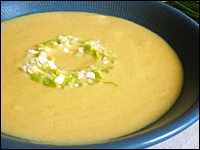
This soup is so luxuriously satiny, you don't need any additional cream, half-and-half, buttermilk or anything else to smooth it out. The corn blends with the stock and gives it an astonishing sweetness, without added sugar.

Makes 4 to 6 servings

6 ears of fresh corn, husked (don't snap off the stalk — you'll need it as a handle)

2 leeks, white parts only

4 cups vegetable or light chicken stock

1 clove garlic

1 bay leaf

Salt and pepper to taste

Chopped scallions or chives for garnish (optional)

Rub the husked ears of corn with a towel to remove the last silk threads. Grasping the stalk end, hold the cob pointing straight down in a large mixing bowl and cut off the kernels with a sharp knife. Set the kernels aside. Break the cobs in half and place them in a stockpot.

Halve the white part of the leeks lengthwise. Rinse them, peeling back the layers to get at any sand trapped between them. Chop them coarsely and add them to the stockpot with all of the remaining ingredients except the corn kernels. Add a little salt to taste. Bring it to a boil and simmer for 25 minutes.

Remove cobs and bay leaf and discard. Taste the stock for seasoning. Then add corn kernels and simmer an additional 5 minutes. Using a blender set on high, puree the soup in batches and strain it through a fine strainer or sieve, discarding any fibrous solids. Chill at least 4 hours.

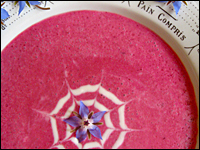
Cool Mixed Berry Soup

Cool Mixed Berry Soup
T. Susan Chang for NPR

This is what my 2-year-old daughter calls "pink soup." Cold berry soups are often made with orange juice, but I prefer cranberry for color and tartness. Naturally sweetened cranberry juice tends to be less toothache-sweet than the high-fructose corn syrup variety. Choose red fruit for a brilliant rosy color, or add blueberries if you like it more purply. This is the soup version of a smoothie, so it's not terribly filling. But it really hits the spot when it's beastly hot outside. Plus, you don't have to turn on the stove even once.

Makes 4 servings

3 cups mixed fresh or frozen berries (raspberries, strawberries and/or blueberries work well)

1 cup cranberry juice (naturally sweetened if possible)

1 cup whole or low-fat yogurt

Juice of 1/2 lemon

1 to 2 tablespoons honey, to taste

A dollop or two of sour cream or creme fraiche for garnish (optional)

In a blender set at high speed, whiz the berries and juice together until you achieve a smooth puree. If you're using frozen berries the puree will be rather slushy. You'll need to stop and scrape down the sides of the blender periodically with a rubber spatula.

Strain the puree to remove any berry seeds or fibers. Place the puree back in the blender and add the yogurt, lemon and honey to taste. Serve with a dollop of sour cream or creme fraiche (or if you really feel like living large, put some sour cream, yogurt or creme fraiche in a squeeze bottle and do what those prep cooks in fancy restaurants do: Make some spirals or dots of cream and then drag a toothpick through them for spectacular effects).

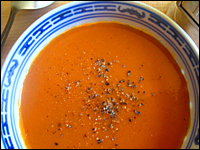
Chilled Roasted Tomato Soup

Chilled Roasted Tomato Soup
T. Susan Chang for NPR

This is a great solution for the too-many-tomatoes problem some of us have in mid-August. If you don't feel like firing up the grill just to make a soup, then grill the vegetables when you're grilling something else. You can hold them, peeled and covered, for a day or two in the fridge. The rest of the soup is easy.

Makes 4 servings

2 pounds ripe tomatoes

1 red bell pepper

1/4 cup olive oil

1 onion, chopped medium

3 garlic cloves, coarsely chopped

1 cup chicken or vegetable stock

Salt and pepper

Preheat a gas grill, or start some coals for a charcoal grill. While the grill is heating, cut a slice off the top and the bottom of the red pepper and reserve. Cut the pepper open; remove the membrane and seeds. Flatten the pepper into one wide strip as best you can.

Remove any tomato stems.

When the grill is hot, place the whole tomatoes and the pepper pieces, including the top and bottom, over the hottest part of the grate. Grill, turning frequently, until they're blackened and blistering on all sides. As they finish, transfer them carefully to a medium-size mixing bowl. Let them rest, covering the bowl with a lid or plate, for 15 minutes or until they're cool enough to handle.

While the tomato and pepper are cooling, place the oil, onion, garlic and a little salt to taste in a heavy pot. Turn the heat to low, cover and sweat for about 25 minutes. Stir a few times to keep them from browning. When they're done, the onions will be translucent and will have given off quite a bit of liquid.

While the onions are sweating, peel the tomato and pepper (discarding any remaining stems) and coarsely chop them. After the onions are done sweating, raise the heat, add the red vegetables and saute over high heat for 5 minutes. Add the stock and simmer an additional 5 minutes.

Using a blender set on high, puree the soup in batches and strain through a fine strainer or sieve, discarding any fibrous solids.

Chill at least 4 hours.

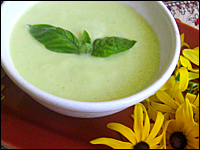
Cool Zucchini Soup

Cool Zucchini Soup
T. Susan Chang for NPR

This is a very satisfying version of the zucchini-mint soup I so enjoyed. I've never quite figured out how to add the flavor of the mint while still preserving the smooth texture. I'm still working on it. But using mint as a fine herbal garnish works well, as does using basil.

Makes 4 servings

1/4 cup olive oil

2 small to medium zucchini, coarsely chopped

1 onion, coarsely chopped

Zest of 1 lemon

1 cup chicken or vegetable stock

1/4 to 1/2 cup buttermilk, to taste

Salt and pepper

Basil or mint sprigs, finely chopped or julienned, for garnish (optional)

Place the oil in a heavy pot. Add zucchini, onion, lemon zest and a little salt to help draw out the juices. Sweat them, covered, for 25 minutes. Check and stir frequently. Don't let the zucchini brown. Don't overcook it, either, or it will take on an unappetizing olive hue.

When the vegetables are quite tender but not mushy, add the stock. Simmer everything together for 5 minutes.

Using a blender set on high, puree the soup in batches and strain it through a fine strainer or sieve, discarding any fibrous solids. Whisk in buttermilk to taste and chill at least 4 hours.

Delicacies From 'Beyond The Great Wall'

Delicacies From 'Beyond The Great Wall', August 3, 2008 · Deep-fried cheese, crepes and carrot salad don't sound like Chinese food. But they are.
Fried cheese momos are a standard snack in Tibet, two-layer crepes are eaten by the Hui people in Qinghai province, and dai carrot salad is from the southern Yunnan city of Jinghong.
These are some of the foods of the 55 tribal groups called "minority peoples" by the Beijing government. These tribes make up 8 percent of China's population, which amounts to more than 100 million people.
Although these communities are not ethnically Chinese, they have lived on land that is now part of China for centuries. This includes Inner Mongolia, the western Silk Road region of Xinjiang and other lands outside central China's westernized cities like Beijing and Shanghai.
Jeffrey Alford and his wife, Naomi Duguid, first traveled widely in these areas in the 1980s, when China opened its borders to outside visitors. When they returned in 2005, they say, they were startled by the changes.
Alford and Duguid say they are worried that the tribal cultures are in danger of disappearing as China explodes economically and more Han Chinese in coastal cities relocate into these interior regions.
Their new book, Beyond the Great Wall: Recipes and Travels in the Other China, tells the story of China's minorities through a gorgeous blend of photography, travelogues and recipes.
Alford says the recipes featured in the book are easy for North American cooks to prepare because they probably have all the necessary equipment in their kitchens. Mix that with ingredients easily found in local markets, and you're prepared to experience delicacies from the farthest reaches of China.

Excerpt: 'Beyond The Great Wall'

Dai Salad
Courtesy of Artisan Books © 2008

NPR.org, August 1, 2008 ·

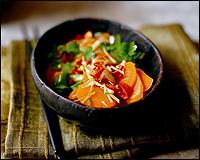
Dai Carrot Salad

This dish is one of an incredible variety of prepared foods available at the markets in the small city of Jinghong in southern Yunnan province. Makes 4 salad or appetizer servings.

Ingredients:

1 pound large carrots

2 tablespoons pickled chiles, cut into ½-inch slices

3 scallions, smashed and sliced into ½-inch lengths

1 tablespoon soy sauce

1 tablespoon rice vinegar

1 teaspoon roasted sesame oil

½ teaspoon salt, or to taste.

2-3 tablespoons coriander leaves, coarsely chopped

Directions:

Peel the carrots. Slice very thin, 1/8-inch thick if possible, on a 45-degree angle. You should have 3 cups.

In a medium saucepan, bring 4 cups of water to a boil. Toss in the carrot slices and stir to separate them. Cook just until slightly softened and no longer raw, about 3 minutes. Drain.

Transfer the carrots to a bowl and let cool slightly, then add the chiles and scallion ribbons and toss to mix.

Whisk together the soy sauce, rice vinegar and sesame oil. Pour over the salad while the carrots are still warm. Stir or toss gently to distribute the dressing, then turn the salad out onto a serving plate or into a wide shallow bowl.

Serve the salad warm or at room temperature. Just before serving, sprinkle on the salt and toss gently, then sprinkle on the coriander and toss again.

Cheese Momos

Cheese made from yak milk is a staple in many parts of Tibet.

Makes 16 half-moon filled breads

Ingredients:

Dough:

1 ½ cups all-purpose flour, preferably unbleached, plus extra for surfaces

½ teaspoon salt

About ½ cup lukewarm water

Filling:

¼ pound dry-textured goat's-milk feta or Pecorino-Romano, crumbled or minced (1 packed cup)

¼ cup minced scallions (white and tender green parts)

Peanut oil for deep-frying (2-4 cups)

Directions:

Place the flour and salt in a food processor and pulse briefly to mix. With the blade running, slowly add the water through the feed tube until a ball forms. Turn out onto a lightly floured surface and knead briefly. The dough should be soft and elastic. Cover with plastic wrap and set aside to rest for 30 minutes to 2 hours, whatever is most convenient.

Mix together cheese and scallions in medium bowl. Set aside.

Cut the dough in half. Set one half aside, covered. On a lightly floured surface, shape the other half into a cylinder by rolling it under your palms. Cut the cylinder crosswise in half, then in half and half again, to give you 8 equal pieces. Work with one piece at a time, leaving the others loosely covered with plastic wrap.

On the lightly floured surface, roll one piece out to a nearly 5-inch round. Place 1 packed tablespoon of the cheese mixture in the center of the round and fold over to make a half-moon shape. Press down lightly with a floured palm, to get rid of air bubbles, then pleat the edges closed. Start at one end and pinch the edges together between thumb and forefinger, then twist the place over, rolling the edge. Move along about ¼ inch and repeat, then continue until the edge is completely sealed. If the dough is not sticking to itself, brush off excess flour and brush the edge with a very little water. Set aside on a lightly floured surface and repeat with the remaining 7 pieces of dough, and then with the remaining dough and cheese.

Place a large wok or deep heavy pot on stovetop, making sure it's stable. (Or use a deep-fryer.) Pour 2 inches of oil into the wok or pot and heat over high heat. To check temperature of the oil, hold a wooden chopstick vertically in the oil, with the end touching the bottom of the pot. If bubbles bubble up along the chopstick, the oil is the right temperature. The oil should not be smoking.

When the oil is ready, slide one momo into the hot oil. Add another, and repeat until you have 4 frying at once. If pot is small, stop before pot is crowded. Use a slotted spoon or wire skimmer to move the momos around and gently turn them. They will quickly turn golden brown with darker brown bubbled spots.

After 1-2 minutes, when they are a rich golden brown and crisped looking, use the slotted spoon or skimmer to transfer to a rack or plate lined with paper towels. Repeat with the remaining momos.

Serve hot.

Calif. Winemaker Offers Personalized Vines

Calif. Winemaker Offers Personalized Vines, July 24, 2008 · Steve Inskeep has today's Last Word in business.

French Winery To Buy Napa's Chateau Montelena

French Winery To Buy Napa's Chateau Montelena, July 24, 2008 · A legendary French winery is purchasing a famous winemaker in California. The deal comes decades after the same California winery beat French wines in a blind taste test.
Deborah Amos talks to Vic Motto, a wine industry investment banker, about the deal. Motto says it's "a very important merger of two great wine estates."

Italy Relents On Boxed Wine (From NPR)

Italy Relents On Boxed Wine, August 5, 2008 · Italy has said it will now allow wine in a box. Ray Isle, deputy wine editor for Food and Wine Magazine, says the change came when Italians realized they couldn't compete in the global market without changing traditional restrictions on regional wines.

2008年8月7日 星期四

Electronic wine-tasting tongue tests grape variety and vintage (From gizmag)

August 6, 2008 Could this new electronic wine-tasting tonguechallenge the finest wine tasters in the world? Invented by European scientists, this handheld device has a multi-sensor chip which senses distinctive characteristics of wine varieties. By analyzing the sugar content, acidity and alcohol, the machine can also determine the year and grape variety of the sample and instead of waiting days for laboratories to analyze wine samples, wine industry specialists will be able to get a sample result at the touch of a button.

Invented by Cecilia Jiménez-Jorquera and colleagues from the Barcelona Institute of Microelectronics, Spain, this handheld device has a multi-sensor chip which senses distinctive characteristics of wine varieties.

“the device could be used to detect frauds committed regarding the vintage year of the wine, or the grape varieties used,” according to Jiménez-Jorquera. The wine-tasting tongue is portable, cheap to manufacture, is capable of being programmed to test for other parameters and can be trained to test new varietals.

Via The Analyst.

2008年8月6日 星期三

Savoring The Spice In Kung Pao Chicken (From NPR)

All Things Considered, August 6, 2008 · When we decided to do a week of All Things Considered broadcasts from Chengdu, China, in May, little did we imagine that we'd find ourselves covering an 8.0 magnitude earthquake. The earthquake hit the day after I arrived in Chengdu.
I had been in Chengdu in April, gathering material for stories to air the next month. I had planned to do one story a day on the food of Sichuan, which is justly famous and utterly delicious
Naturally, the earthquake put those stories on hold.
Now, here's one of those stories, from a day I spent at The Sichuan Higher Institute of Cuisine in April. It's a prestigious cooking school in Chengdu that is training the next generation of chefs. The school reopened just a couple of days after the earthquake.
The Lure Of Sichuan Food
Sichuan food is famous for its mouth-numbing, spicy heat. And in the time I spent in Chengdu, I grew especially intrigued by a singular Sichuan sensation: ma.
Ma means "numbing" in Chinese, and that numbing sensation is a distinctive characteristic of Sichuan food. It comes from the Sichuan peppercorn, hua jiao, which translates to "flower pepper."
These peppercorns are not to be confused with hot red chili peppers. In fact, the Sichuan peppercorn isn't a pepper at all. It's an aromatic berry from the prickly ash tree.
When they're dried, the peppercorns turn a beautiful purple, and they're used with abandon in many dishes.
And there's another use: I've learned that you can put a peppercorn in your mouth to numb a toothache.
That was one lesson among many I learned during the day I spent at the Sichuan Higher Institute of Cuisine.
Layers Of Flavor
My teacher at the school, Li Jianqing, challenged me to bite into a Sichuan peppercorn. He told me a Swiss visitor had tried, but couldn't handle it.
Well, I couldn't resist that challenge, so I popped a peppercorn into my mouth and chomped down hard. Right away, my tongue started to tingle. Then, the sensation spread. My mouth started buzzing, dancing with a fizzy heat. The tingling moved from my tongue to my lips — it was a good tingling, not painful. Bit by bit, the taste filled my mouth — fragrant and a little bit sour.
Then, we got down to business. Li gave me a cooking demonstration, expertly stir-frying a wokful of a classic Sichuan dish: Kung Pao chicken, or chicken with peanuts, flavored with hot chilies and Sichuan pepper.
Before I left for Chengdu, the food writer Fuchsia Dunlop told me I had to eat Kung Pao chicken there. She said it would taste totally different from the dish I'd eaten many times in Chinese restaurants in the U.S.
And she was right. When I sampled Li's Kung Pao chicken, it had layers of flavor I had never tasted before.
My Turn To Sweat
Then Li challenged me again: "Can you do this dish?"
There's only one answer to that.
So, I put on a white chef's hat and got to work on the Kung Pao chicken. First, I mixed up the sauce — black vinegar, soy sauce, salt and sugar, mixed with corn starch and water — and poured it over the diced chicken. Li turned the gas on under the wok, and the flame roared up fiercely around it.
I tossed the chicken in the wok and started stir-frying, maybe a bit too energetically.
"Relax!" Li told me. Easy for him to say.
It turns out, stir-frying in a mock professional kitchen is harder than it looks. The wok was heavy and seemed huge. I held one handle with my left hand, which was wrapped in a towel to protect it from the heat. But it was an awkward grip, and when it came time to slide the chicken out of the wok, I lost some in the process.
Into the wok went hot chilies and those famous Sichuan peppercorns. Then, ginger, garlic and scallions. Last, I dumped the chicken back in, stir-fried it all together, and that was it.
Finally, the moment of truth. Li took a bite.
"It's very good," he said. "It's better than mine."
But I knew he was just being kind to a visitor. And he was too polite to mention that I had burned the chilies.

Gong Bao (Kung Pao) Chicken with Peanuts
(Gong Bao Ji Ding)
NPR.org, May 2, 2008 · This dish, also known as Kung Pao chicken, has the curious distinction of having been labeled as politically incorrect during the Cultural Revolution. It is named after a late Qing Dynasty (late nineteenth century) governor of Sichuan, Ding Baozhen, who is said to have particularly enjoyed eating it — gong bao was his official title. No one can quite agree on the details of its origins: some say it was a dish Ding Baozhen brought with him from his home province of Guizhou; others that he ate it in a modest restaurant when he went out in humble dress to observe the real lives of his subjects; still others, rather implausibly, that his chef invented the finely chopped chicken dish because Ding Baozhen had bad teeth. Whatever the truth of its origins, its association with an imperial bureaucrat was enough to provoke the wrath of the Cultural Revolution radicals, and it was renamed "fast-fried chicken cubes" (hong bao ji ding) or "chicken cubes with seared chiles" (hu la ji ding) until its political rehabilitation in the 1980s.
Gong Bao chicken is beautiful to look at: a glorious medley of chicken flesh, golden peanuts and bright red chiles. The sauce is based on a light sweet-and-sour, pepped up with a deep chile spiciness and a trace of Sichuan pepper that will make your lips tingle pleasantly. The ingredients are all cut in harmony, the chicken in small cubes and the scallion in short pieces to complement the peanuts. The chicken should be just cooked and wonderfully succulent; the nuts are added at the very last minute so they keep their crispness.
Serves 2 as a main dish with a simple stir-fried vegetable and rice, 4 as part of a Chinese meal with three other dishes
2 boneless chicken breasts, with or without skin (about 2/3 pound total)
3 cloves of garlic and an equivalent amount of fresh ginger
5 scallions, white parts only
2 tablespoons peanut oil
a generous handful of dried red chiles (at least 10), preferably Sichuanese
1 teaspoon whole Sichuan pepper
2/3 cup roasted unsalted peanuts
For the marinade:
1/2 teaspoon salt
2 teaspoons light soy sauce
1 teaspoon Shaoxing rice wine or medium-dry sherry
1 1/2 teaspoons potato flour or 2 1/4 teaspoons cornstarch
1 tablespoon water
For the sauce:
3 teaspoons sugar
3/4 teaspoon potato flour or 1 1/8 teaspoons cornstarch
1 teaspoon dark soy sauce
1 teaspoon light soy sauce
3 teaspoons Chinkiang or black Chinese vinegar
1 teaspoon sesame oil
1 tablespoon chicken stock or water
1. Cut the chicken as evenly as possible into 1/2-inch strips and then cut these into small cubes. Place in a small bowl and mix in the marinade ingredients.
2. Peel and thinly slice the garlic and ginger, and chop the scallions into chunks as long as their diameter (to match the chicken cubes). Snip the chiles in half or into 2-inch sections. Wearing rubber gloves, discard as many seeds as possible.
3. Combine the sauce ingredients in a small bowl — if you dip your finger in, you can taste the sweet-sour base of the gong bao flavor.
4. Season the wok, then add 2 tablespoons of oil and heat over a high flame. When the oil is hot but not yet smoking, add the chiles and Sichuan pepper and stir-fry briefly until they are crisp and the oil is spicy and fragrant. Take care not to burn the spices (you can remove the wok from the heat if necessary to prevent overheating).
5. Quickly add the chicken and fry over a high flame, stirring constantly. As soon as the chicken cubes have separated, add the ginger, garlic, and scallions and continue to stir-fry for a few minutes until they are fragrant and the meat is cooked through (test one of the larger pieces to make sure).
6. Give the sauce a stir and add it to the wok, continuing to stir and toss. As soon as the sauce has become thick and shiny, add the peanuts, stir them in, and serve.
Variations
The same dish can be made with cubes of pork, shrimp, or prawns.
Cashew nuts can be used instead of peanuts for a grander version of this dish, although peanuts are more traditional.
Reprinted from Land of Plenty: Authentic Sichuan Recipes Personally Gathered in the Chinese Province of Sichuan by Fuchsia Dunlop. Copyright (c) 2001 by Fuchsia Dunlop. With permission from the publisher, W.W. Norton & Company, Inc.